
Official awards of the 39th Tokyo International Film Festival (TIFF) were announced in Japan and a grand prize the Best Film award in the established “Competition” was awarded to comedy-drama film Sister Brother Manhole Cover directed and written by Milcho Manchevski.
According to the report of Mansour Jahani, an independent and international film journalist, the closing ceremony of the 39th Tokyo International Film Festival (TIFF) at Hulic Hall Tokyo, in Tokyo, Japan, recipients were announced was held, for a range of awards, culminating in the Tokyo Grand Prix, The Governor of Tokyo Award, which comes with 3 million yen in prize money.
Awards for the established Competition
The members of the jury for the established Competition at the 39th Tokyo International Film Festival (TIFF) who were; Rolf de Heer Dutch-Australian film director - President of the Jury, Alex Lo taiwanese-American filmmaker, producer, Oh Jungwan film producer (South Korean), Watanabe Makiko actress (Japan), and Yov Moor film producer (France); announced their opinions as follows:
Best Film Award
Tokyo Grand Prix, The Governor of Tokyo Award, to: “Sister Brother Manhole Cover” directed and written by Milcho Manchevski (North Macedonia, Bulgaria, Serbia, Albania, Italy, and UK)
International Competition Jury President Rolf de Heer praised “Sister Brother Manhole Cover” for its “seamless blending of humor, tragedy and drama” and the “humanity and compassion shown toward its characters.”
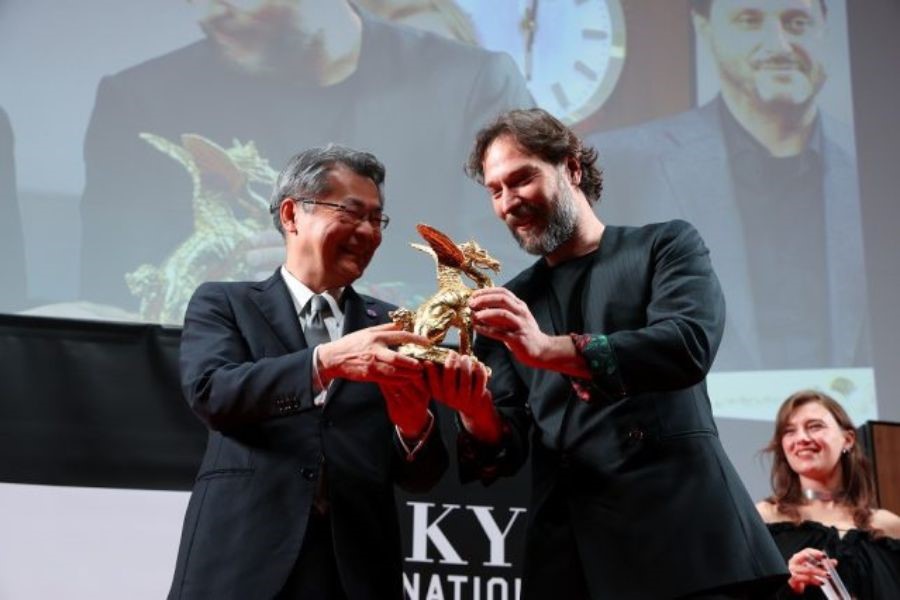
Accepting the award on behalf of the director, producer Jane Kortoshev remarked, “We came to Tokyo with a manhole cover and we’re going back to Macedonia with this beautiful award. I’d say it’s a pretty good deal.”
Manchevski, appearing via video, expressed his delight: “I’m so happy Tokyo loves our manhole cover, because Tokyo International Film Festival is one of my favorite festivals in the world.”
Special Jury Prize
Special Jury Prize: “Magic Atlas” directed by Sun Xun (Singapore)
“Magic Atlas” recognized for its imaginative combination of reality and fantasy, history and myth.
Sun Xun, who spent 10 years making the film, expressed his surprise and gratitude, thanking his family and team for their support.
Award for Best Director
Award for Best Director, to: Lisandro Alonso for directing the feature film “Double Freedom” (Chile, Argentina, Luxembourg, Germany, and UK)
The jury commending his restrained cinematic language and precise depiction of the passage of time.
Award for Best Actress
Award for Best Actress, to: Hu Ling for acting in the “The Night That Binds” directed by Wang Jiangyong (US, France, and Hong Kong)
The jury praising her deeply moving portrayal of loneliness, strength and sadness.
Award for Best Actor
Award for Best Actor, to: Narita Ryo for acting in the “Two Cigarettes, Three Nights” directed by Mishima Yukiko (Japan)
Director Mishima Yukiko accepted the award on his behalf, warmly praising his performance and the depth he brought to the film.
Award for Best Artistic Contribution
Award for Best Artistic Contribution, to: “Until the Day Ends” directed by Jelena Maksimović, recognized for its cinematography (Serbia, Bulgaria, Slovenia, Montenegro, Croatia, and Germany)
Audience Award
Audience Award, to: “Heysel 85” directed by Teodora Ana Mihai (Belgium, The Netherlands, and Germany)
Mihai, expressed her surprise: “I was expecting to give awards tonight, not to receive one. When we make a film, we always hope that it will resonate. There’s always a fear that it won’t.”
Asian Future Competition
The jury members of the “Asian Future Competition” at the 39th Tokyo Film Festival who were; Eiko Mizuno-Gray film producer (Japan), Fujimoto Akio film director and screenwriter (Japan), and Yulia Evina Bhara film producer (Indonesia); announced their opinions as follows:
Best Film Award
Best Film Award, to: “Serife Tavsan” directed by Tareq Daoud (Switzerland, and Turkey)
Juror Fujimoto Akio praised its powerful portrayal of a protagonist overcoming prejudice and oppression while reconnecting with others.
Special Mention
Special Mention, to: “Jani Be Good” directed by Ariani Darmawan (Indonesia)
Nippon Cinema Now Competition
The jury members of the The newly established “Nippon Cinema Now Competition” awards Sat the 39th Tokyo Film Festival who were: Mathieu Macheret film journalist (France), Murata Chieko film producer (Japan), and Sabrina Baracetti the Udine festival of Asian films (Italy); announced their opinions as follows:
Best Film Award
Best Film Award, to: “silver express” directed by Tanaka Miki (Japan)
Special Jury Prize
Special Jury Prize, to: “Between Us” directed by Matsumura Shingo (Japan)
Asian Students’ Film Conference
The jury members of the “Asian Students’ Film Conference” at the 39th Tokyo Film Festival who were: Barbara Wurm film critic and film scholar (German), Teodora Ana Mihai film director (Romania), and Ema Ryan Yamazaki filmmaker and film editor (Japan); announced their opinions as follows:
Grand Prix
Grand Prix, to: “Running Wild in the Sun” directed by Nguyen Vu Hien Chi (Vietnam)
The jury praised its cinematic vision and emotional honesty, noting that its script and execution surpassed expectations for a student film.
Special Jury Prize
Special Jury Prize, to: “Everything’s Peachy” directed by Nah Yee Chern (Singapore), and “All of Her” directed by Kim Nam-hyeon (Korea)
TIFF Ethical Film Award
The jury members of the “Ethical Film Award” at the 39th Tokyo Film Festival who were: Japanese actor Isomura Hayato - Jury President, and Student PR Team; announced their opinions as follows:
Ethical Film Award
TIFF Ethical Film Award, to: “I Rarely Wake Up Dreaming” directed by Isabelle Stever (Germany, and Ukraine)
O Mipo and Mohammad Rasoulof Receive Kurosawa Akira Award at 39th TIFF
The award honors the renowned auteur’s legacy and ongoing influence, and is presented to filmmakers who have made waves in cinema and are expected to help guide the industry’s future. The award was revived in 2022 after a 14-year hiatus, with the generous support of Capcom Co., Ltd. Last year’s recipients were notable filmmakers Lee Sang-il and Chloé Zhao.
At a black-tie event later that evening, Japanese film industry leaders and notable international guests gathered at the Imperial Hotel for the Kurosawa Akira Award Ceremony.
TIFF Festival Director Hisamatsu Takeo, noting that Kurosawa’s films continue to move audiences around the world, transcending generations, national borders and cultural differences, Hisamatsu said: “It is a great pleasure and honor to present this year’s Kurosawa Akira Award to two filmmakers who carry that spirit forward into the future: O Mipo and Mohammad Rasoulof. Through their distinctive perspectives and artistic approaches, both directors challenge us to reflect on human dignity and the nature of society.”
Rasoulof and O Mipo the two laureates of the 39th Tokyo International Film Festival’s Kurosawa Akira Award were chosen by a selection committee comprising veteran filmmaker Yamada Yoji, who served as chair; director Lee Sang-il, recipient of last year’s Kurosawa Akira Award; acclaimed cinematographer Ashizawa Akiko; and TIFF Programming Director Ichiyama Shozo. The committee recognized O for her multifaceted portrayals of people on the margins of society, particularly children, and Rasoulof for his uncompromising examination of injustice and oppression.
Although their careers have unfolded under vastly different circumstances, both directors spoke about the deeply personal experiences that shape their work and their shared belief in cinema’s ability to foster understanding, compassion and hope.
Two Filmmakers, Two Different Journeys
For O, receiving an award bearing Kurosawa’s name initially seemed almost too good to be true. “What makes me especially happy is receiving this award alongside Mohammad Rasoulof, a filmmaker whose work I deeply admire. It is both an honor and a humbling experience.”
Of all Kurosawa’s films, “Dersu Uzala” is the one I love most
Rasoulof said receiving the award had particular significance at a time when violence was so widespread throughout the world. “Of all Kurosawa’s films, Dersu Uzala is the one I love most. It is a profoundly anti-violence film, and it has been a great source of inspiration to me.”
The Enduring Influence of Kurosawa
Both filmmakers spoke of Kurosawa’s profound influence on their work.
O recalled first encountering Rashomon as a university student and later learning about Kurosawa through director Obayashi Nobuhiko, whose staff she joined after graduation. Obayashi had made a behind-the-scenes documentary about Kurosawa’s Dreams, which O watched repeatedly. “His films and the documentaries about their production have become something like textbooks for me,” she said.
Watching Dersu Uzala helps me recover my sense of hope
Rasoulof recalled watching Red Beard repeatedly on Iranian state television as a child. Later, as a filmmaker, he came to admire Kurosawa’s extraordinary control over every element of his films. But it was Dersu Uzala that moved him most profoundly. “Even today, whenever I feel hopeless or discouraged, I return to Dersu Uzala. Watching it helps me recover my sense of hope.”
O Mipo: To receive such an honor fills me with a deep sense of gratitude and humility
To receive such an extraordinary honor on the 20th anniversary of my directorial debut fills me with immense gratitude and deep humility. Winning the Shindo Kaneto Award in 2010 provided me with the vital support to keep making films. Though my progress has been slow, reaching the Kurosawa Akira Award is a stroke of fortune that makes me truly savor what a happy cinematic journey I have had. This recognition is by no means mine alone. My heartfelt thanks go to all the cast and crew members I have met along the way, the audience who stepped into the theaters, and the selection committee—led by director Yamada Yoji—who discovered my films. Finally, my deepest love and thanks go to my sons and husband, who never give up on me, no matter how scattered I am every day.
Mohammad Rasoulof: Receiving the Kurosawa Award is a great honor for me
Receiving the Kurosawa Award is a great honor for me. His films are profound explorations of the human condition and the moral choices we make in moments of crisis. Kurosawa was a dynamic and inquisitive visual storyteller whose unique perspective on humanity, nature, and the world has made his work an enduring source of inspiration in cinema.
That a film festival should celebrate cinema in all its forms
Bringing the ceremony to a close, Tokyo International Film Festival Director Hisamatsu Takeo thanked the filmmakers, audiences, guests and supporters who had contributed to the festival’s success. He emphasized his belief that a film festival should celebrate cinema in all its forms, including works that challenge audiences and confront difficult realities.
The milestone 40th Tokyo International Film Festival edition in 2027
Looking ahead to the milestone 40th edition in 2027, Hisamatsu expressed his ambition to make the festival “more diverse, more vibrant, more spectacular and more festive than ever before.”
Showcased films by directors from various countries across
The 39th Tokyo International Film Festival (TIFF), showcased 204 films by directors from various countries across in several competition, including; the Main Competition, Asian Future Competition, Nippon Cinema Now Competition, as well as out of competition including; the Gala Selection, the World Focus section, the Animation section, the Japanese Classics section, the TIFF Teens Meet Cinema Youth section, the Women's Empowerment section, and the Asian Students' Film Conference section, CROSSCUT ASIA+ section, etc, it was held from Oct 26, 2026 – Wed, Nov 4, 2026, in Tokyo, Japan,
Credit images from the website of the Tokyo Film Festival
For more details: TIFF
Tokyo International Film Festival 2026: Sister Brother Manhole Cover Wins Grand Prix