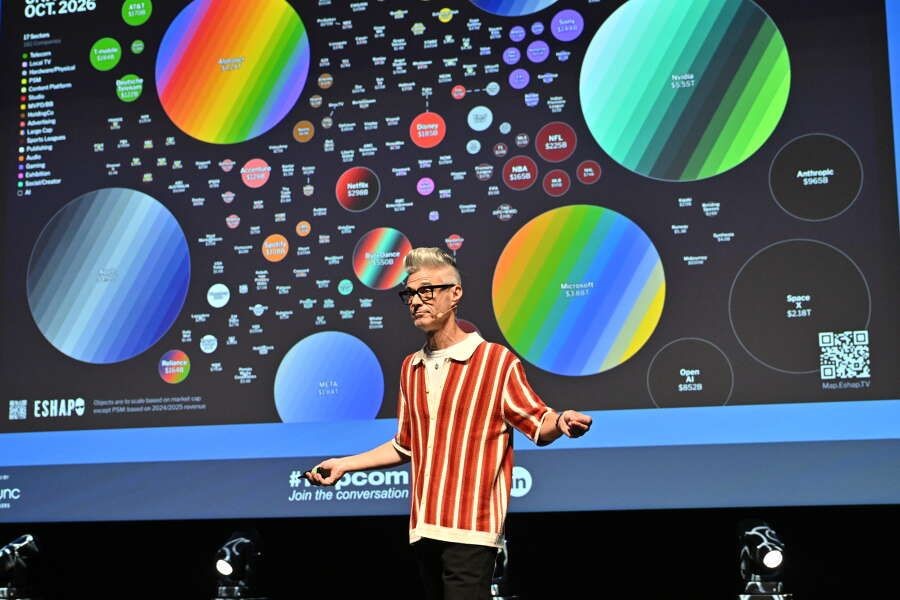

At MIPCOM Cannes 2026, media analyst Evan Shapiro, widely known as the Media Cartographer, delivered one of the most provocative presentations on the future of the global television industry. His keynote, titled MIP HEADLINER: The Whole Consumer: Following Audiences From the Couch to the Loo, challenged broadcasters, producers and distributors to rethink their strategies in an increasingly fragmented media landscape.
The central message was straightforward: the industry must stop focusing exclusively on platforms and start following audiences wherever they go.
"We are squarely in the user-centric era," Shapiro told delegates, explaining that the transformation of the media ecosystem is driven not simply by technological innovation but by generational change. Millennials, Gen Z and the emerging Generation Alpha are reshaping the way content is discovered, consumed and monetised. According to Shapiro, 81% of the world's population is under 55, making these consumers the dominant force behind the evolution of media.
Drawing on research conducted across 23 markets, Shapiro demonstrated how the traditional concept of television viewing has changed dramatically. The living room is no longer the centre of the viewing experience. In many countries, including the United States and the UK, the bedroom has become the most frequently mentioned location for watching video, while younger generations increasingly consume content on smartphones while commuting, waiting in line or even in the bathroom.
This changing behaviour explains why the industry is witnessing such rapid growth in mobile-first entertainment. Television has not simply been replaced by streaming, as many executives initially predicted. Instead, it has evolved into what Shapiro describes as personalised television, combining premium streaming and social video across connected TVs, smartphones and multiple digital platforms.
To illustrate this transformation, Shapiro introduced the latest version of his interactive Media Universe Map, a tool designed to monitor audience engagement and the changing balance of the global media ecosystem. Unlike traditional industry maps focused on corporate valuations, his approach places audience behaviour at the centre, allowing users to explore how consumption patterns have evolved over time.
One of the most significant findings concerns the growing influence of YouTube and TikTok. According to Shapiro's cross-screen attention research, YouTube leads engagement across screens in several major markets, while TikTok has become particularly dominant among audiences under 25. Traditional television brands continue to attract significant audiences, especially among older generations, but social video platforms are increasingly shaping younger consumers' viewing habits.
Shapiro argued that YouTube's competitive advantage comes from its ability to accompany consumers throughout the day, offering content on smartphones during their commute and on television screens when they return home. This flexibility makes it a powerful competitor to traditional broadcasters and subscription streaming platforms.
However, the real challenge for media companies is not simply to increase reach. Shapiro believes that the industry is entering what he calls the affinity economy, in which engagement, loyalty and community are becoming more valuable than traditional audience metrics.
"We are in the affinity economy," he stated, stressing that successful media brands must create meaningful relationships with consumers rather than focus exclusively on ratings or subscriber numbers.
This shift is particularly important at a time when premium streaming services face increasing pressure from subscriber churn. Shapiro pointed out that advertising is becoming an increasingly important source of revenue across the media industry, with digital and social platforms capturing a growing share of the market. For broadcasters and producers, this means that cultivating loyal communities and developing intellectual property capable of travelling across platforms is becoming essential.
Several examples presented during the keynote demonstrated how established media companies are already adapting. France Télévisions has embraced collaborations with digital creators and is investing in premium vertical content, while Spain's RTVE is exploring new ways to reach younger audiences through social platforms and creator-led journalism. RTL has also discovered new opportunities by distributing existing television content on YouTube. According to Shapiro, the strategy has allowed the company to reach a younger and more male audience than its traditional television viewers, while also helping to generate subscriptions to RTL+.
BBC Studios represents another example of this multiplatform approach. Through the international success of Bluey, the company has demonstrated how television intellectual property can develop into a broader entertainment ecosystem combining streaming distribution, YouTube content, brand partnerships and audience engagement.For Shapiro, these examples challenge the long-standing assumption that social video necessarily cannibalises traditional television. He argued that distributing content across multiple platforms can instead attract new viewers, strengthen brand awareness and generate additional revenues.
A particularly relevant development for the international television market is the rise of premium vertical content. Shapiro highlighted how major players, including Netflix, Disney, France Télévisions and BBC, are increasingly exploring professionally produced mobile-first entertainment. The expansion of vertical series and microdramas is creating new opportunities for producers and distributors, particularly as advertising-supported models become more important.
He also pointed to Fremantle's plans to reinvent the long-running Australian soap Neighbours for vertical viewing, demonstrating how established television franchises can be adapted to new storytelling formats and consumer habits. The transformation is not limited to scripted entertainment. Sports organisations and broadcasters are also recognising the importance of combining traditional coverage with social video. Shapiro highlighted the example of Brazil's CazéTV, whose YouTube coverage of the FIFA World Cup attracted enormous audiences while traditional broadcaster Globo continued to achieve strong viewing figures. Rather than competing in a zero-sum environment, the two platforms demonstrated how different distribution models can coexist and expand overall engagement.
Another important element of Shapiro's presentation concerned the emergence of creator-led business models. He cited animation company Toonstar, which combines AI-assisted production with direct distribution, and World of Wonder, the company behind RuPaul's Drag Race, as examples of businesses that have developed strong relationships with their audiences and greater independence from traditional commissioning structures.
In the case of RuPaul's Drag Race, Shapiro highlighted the remarkable loyalty of the franchise's fan community and the success of World of Wonder's direct-to-consumer strategy, demonstrating how a powerful intellectual property can generate long-term value beyond its original television distribution.
Ultimately, Shapiro's presentation was a call for the industry to redefine the concept of broadcasting itself. In his view, broadcasting should no longer be associated with a particular technology, channel or television screen, but with the ability to communicate with audiences across every available platform.
For producers, distributors and broadcasters attending MIPCOM, the implications are significant. The future of television will increasingly depend on the ability to create content that moves naturally between linear broadcasting, streaming, social platforms and vertical video, while developing lasting relationships with audiences.
The question is no longer whether viewers will abandon traditional television, but whether television companies are prepared to follow them into a new, mobile-first and creator-driven media economy.
Evan Shapiro at MIPCOM Urges the TV Industry to Follow Audiences Beyond the Living Room