
Music should not be treated as an afterthought in audiovisual production. This was the central message of the panel Haciendo realidad la visión musical (Bringing the Musical Vision to Life), held during the 22nd edition of CIIF Market on October 28 inside the Mencey Hotel.
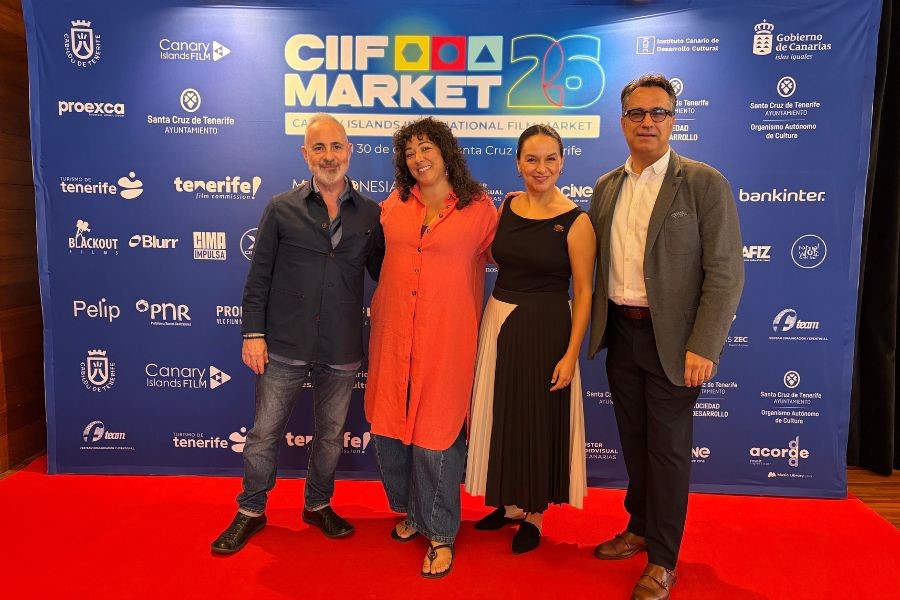
The discussion brought together Patricia Carrera, President of ASM (Association of Music Supervisors); Diego Navarro, composer and director of FIMUCITÉ; Nuria Hernández, President of the Canary Islands Music Cluster; and Arturo Olea, Director of Music Library & SFX.
The speakers examined the creative, financial and legal challenges of integrating music into film and television productions, highlighting the importance of collaboration between composers, music supervisors, producers and rights holders.
Music Is Not Just Post-Production
Patricia Carrera challenged one of the audiovisual industry’s most persistent misconceptions: that music should only be considered during post-production. According to Carrera, music supervision should begin at the earliest stages of a project, influencing creative development, budgeting, production planning and distribution. She explained that music supervisors coordinate not only composers and licensing agreements but also music-related activities on set, legal clearances, technical requirements and collaboration across production departments.
Their involvement can extend from the initial development of a film or series through to its release, including trailers and promotional materials.
Canary Islands-born composer Diego Navarro, also director of the Tenerife International Film Music Festival (FIMUCITÉ), offered insights into the complex process behind creating an original soundtrack. Navarro explained that composing for audiovisual productions involves a much larger team than audiences might imagine, including orchestrators, music editors, recording engineers, orchestra contractors and musicians. He stressed that involving composers early allows them to understand the director’s vision, the narrative requirements and the scale of the production. The creative approach, he noted, must also reflect the available budget. Not every project requires a symphony orchestra: sometimes a smaller ensemble can provide the most effective musical solution. For Navarro, the essential starting point is understanding the story and determining how music can contribute to its emotional and dramatic impact.
Music Libraries as an Alternative for Producers
Arturo Olea, Director of Music Library & SFX, focused on the opportunities offered by production music catalogues, particularly for projects working with limited budgets.Unlike commercial recordings by internationally recognised artists, production music is specifically created for synchronisation in audiovisual content. Olea explained that music libraries can offer a cost-effective alternative to expensive commercial tracks, providing producers with access to professionally recorded compositions across a wide variety of genres. His company represents a catalogue of approximately 400,000 tracks, regularly expanded with new music, and works with composers and recording studios internationally, including talent from Spain and the Canary Islands. He also highlighted the advantages of one-stop licensing, which simplifies rights clearance by allowing producers to obtain the necessary permissions through a single licensing arrangement.
The discussion also addressed the distinction between composition rights and sound recording rights, an essential consideration when budgeting for existing music.
Olea emphasised that the music represented by his company is human-made, reinforcing the value of composers and performers at a time when artificial intelligence is transforming the creative industries.
The Canary Islands’ Musical Talent and Industry Potential
Nuria Hernández, President of the Canary Islands Music Cluster, highlighted the importance of strengthening connections between the region’s music and audiovisual industries.
She explained that the cluster has spent several years working to bring together a fragmented music sector, improve institutional dialogue and create new professional opportunities.
While the Canary Islands have successfully developed an internationally recognised audiovisual production ecosystem, Hernández believes similar collaboration could strengthen the local music industry. She also pointed to the significant pool of musical talent in the archipelago, arguing that many local artists and composers remain insufficiently connected to audiovisual production opportunities. Greater cooperation between the two sectors could help local musicians access international projects while reinforcing the islands’ position as a creative production hub.
The discussion also addressed the growing impact of artificial intelligence on music composition, raising important questions about copyright, intellectual property and the protection of creative talent.The message from the panel was clear: until an internationally recognised legal framework regulating the use of AI in music composition is established, human creativity should remain at the heart of the creative process.
In this context, the speakers highlighted a growing contractual approach aimed at protecting original compositions, with agreements explicitly prohibiting the use of generative AI in music creation. Such provisions seek to ensure that music remains the result of human artistic work, safeguarding composers' rights and the authenticity of their creative contributions.
While AI may offer opportunities to support production workflows, the panel emphasised that technology should not replace human creativity, particularly in an industry where artistic identity, originality and intellectual property remain fundamental assets.