
The media conference was held under the theme ‘Freedom, Meaning, Security’, and the host, Frank Apfel, MD of Apfel Programm Marketing, described the aim of the event as answering the question: ‘How can we help people enter a positive upward spiral?’. The focus was on the topics of transformation and, of course, AI and its implications, ranging from the human psyche to the optimisation of production processes.
Philosopher, and author Dr Rebekka Reinhard gave a keynote entitled “Human is the next big thing” on people’s anxieties in the age of AI, the “exhausting ambiguity” as the “new normal”, and emphasised that even for the philosophers of antiquity, constant transformation was the norm – a concept described by Heraclitus as “everything flows”.
She warned against ‘self-victimisation’ (a person’s conscious or unconscious behaviour of portraying themselves as a victim of circumstances) and ‘confirmation bias’ (the tendency to unconsciously search for, interpret, favour and recall information that supports one’s pre-existing beliefs). Among other things, she recommended ‘slow efficiency’ as a way of focusing on what really matters at a ‘human pace’.
Steffanie Bubbers, Director at PwC Germany, presented the key findings of the latest “German Entertainment & Media Outlook 2026–2030”.
The study found that the German entertainment and media market is increasingly evolving into a data- and platform-driven advertising and infrastructure market, in which traditional revenue streams are becoming less significant. It was reported that the German entertainment and media market had grown moderately to around EUR 117 bn. in 2025 (+3.3 per cent), showing overall stability whilst undergoing structural change. Furthermore, the market is said to have continued to shift clearly towards digital revenues: digital revenues (excluding connectivity) are reported to have risen to EUR 38.9 bn. (+7.8 per cent), whilst non-digital revenues are said to have fallen to EUR 44.3 bn. (–1.2 per cent).
According to the study, Germany, by international standards, remains a large and stable market with moderate growth momentum. Growth is concentrated in a few large, digital and data-driven segments, whilst traditional revenue sources are under structural pressure and are gradually losing their significance. It was noted that platformisation is becoming the dominant structural principle. Control over interfaces with users, data and monetisation determines visibility and market position. Furthermore, traditional providers are increasingly operating within platform-dominated value chains, in which global tech players shape access to end customers and help define the rules of the game in marketing.
Bubbers explained that, in the past, greater reach also meant higher revenue. These days, it is the platform that calls the shots, and access is becoming more important than reach. She recommended that companies should refine their platform strategy and adopt a cross-segment approach. First-party data is fundamental, with efficiency and monetisation as key issues, as well as the active management of consolidation.
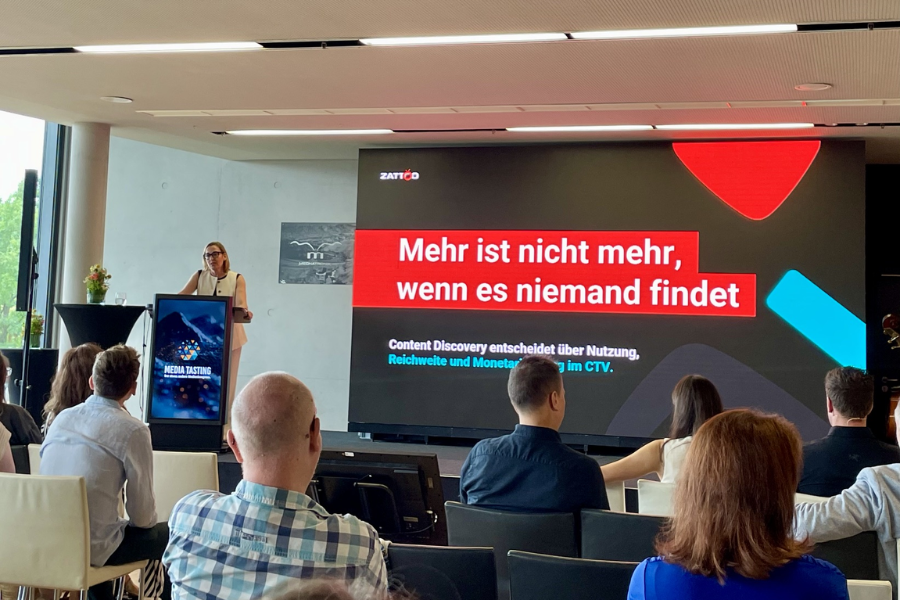
Tina Rodriguez, Chief Consumer Officer at the OTT platform Zattoo, highlighted the “choice paralysis” caused by the vast range of content on offer: “If you can’t be found, you won’t be watched; if you aren’t watched, you won’t be monetised.” She emphasised that good UX is not just a “nice to have”, but is crucial to the commercial success of everyone involved in the value chain. “More isn’t more if nobody can find it.” The answer, she said, lies in AI: “There will be an end to the graveyard of tiles. In future, I’ll see on my home screen what I’m genuinely interested in.” Rodriguez emphasised the immense importance of metadata and that AI-powered technologies would enable far better recommendations.
Dr Nele Meissner presented the new ‘wedium’ platform, a European social media platform designed as an alternative to the major providers from the US, and China. According to Meissner, one in two young people show symptoms of social media addiction. These days, there are hardly any opportunities for monetisation on existing platforms; brands are placing adverts in questionable contexts; and opaque algorithms are putting democracy under pressure because hate speech is on the rise.
The key distinguishing features of ‘wedium’ are that every user is verified, meaning there are no bots or fake accounts. Furthermore, it is built and hosted in Europe to GDPR standards, outside the scope of the US CLOUD Act. There would also be ‘fair remuneration’ for creators, media organisations and NGOs, as 50 per cent of advertising revenue would be paid out to content producers. The official launch is scheduled for 31 July, and a European roll-out is planned from October 2026.
In a light-hearted speech, the long-serving managing director of the ZEIT publishing group shared anecdotes about how, over the course of 27 years, he and his team had quadrupled the newspaper‘s turnover despite the media crisis, and expanded the workforce from 300 people at the start of his tensure to 1,400 by 2026. He emphasised the importance of a good corporate culture, respect and a culture of learning from mistakes, which he said was essential for staff to try new things: “If something doesn’t work, that’s a step forward in learning.”
Employees should be allowed to “take on responsibility quickly and make mistakes quickly”. Innovation is anarchic, and new ideas are generally great to begin with. Saying “Yes, but…” is forbidden. He emphasised that one must have trust and invest, albeit to a manageable extent, and that “the best market research is when the product is on the market.” If it proves successful, it can be expanded. This is how they’ve handled it with various products, and one result of this was the launch, ten years ago, of the ‘Zeit Verbrechen’ podcast, which now has 5 to 6 million downloads and appeals to a target audience that ‘Die Zeit’ hadn’t previously focused on: younger women.
Wiebke Wiesner, who had only just taken over as managing director of the local Media and Film Society MFG Baden-Württemberg – an institution of the state and the local public broadcaster – on 1 July, explained that her aim was to bring together the creative, film and media sectors in Baden-Württemberg and to strengthen their long-term viability in a sustainable manner.
Dr Wolfgang Kreißig, head of the LFK, State Media Authority Baden-Württemberg, emphasised that media diversity, journalistic quality and media literacy are key prerequisites for a functioning democratic public sphere. At the same time, he pointed out that platforms and new technologies such as artificial intelligence are changing the conditions under which media are produced and consumed. This is why dialogue between media organisations, politicians, academia and regulators is so important.
At the networking reception that followed, featuring a wine tasting on the rooftop terrace of the MHP Arena, visitors took the opportunity to deepen their discussions and make new contacts as well as watch football.
And with the weather changing from sunshine to a downpour and then to a rainbow, it served as a perfect metaphor for the current situation facing the media in Germany and beyond.
in Germany, Lühr-Martin Lemkau - photo Media Tasting