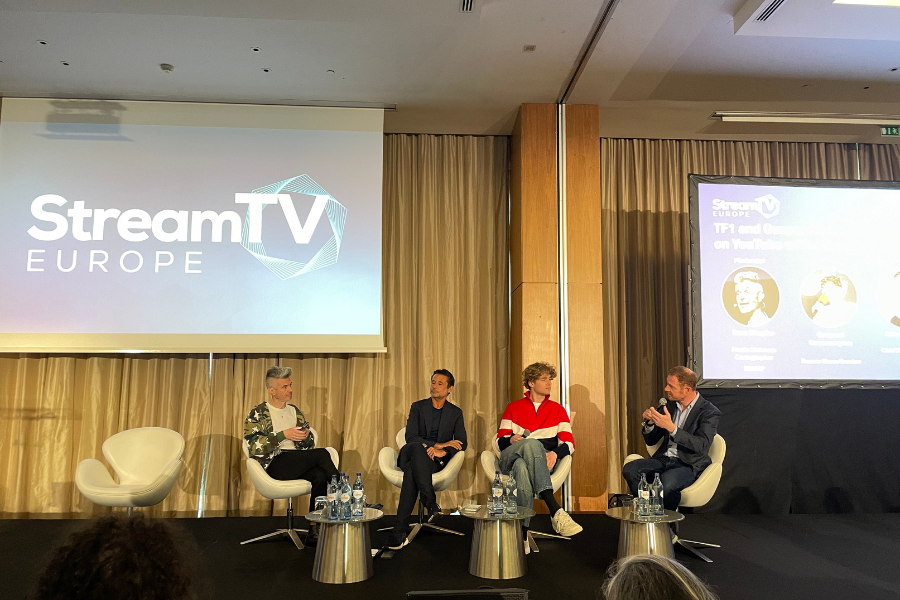

One of the most interesting conversations on the future of journalism took place on the opening day of StreamTV Europe, held in Lisbon from April 13-15, 2026 at the Epic Sana Hotel. Moderated by Evan Shapiro, the panel “TF1 and Gaspard G Are Transforming Journalism on YouTube with a Creator Mindset” brought together three very different but highly complementary voices: Julien Laurent, Chief Digital Officer at TF1; Pedro Pina, Vice President YouTube Europe; and Gaspard Guermonprez, one of France’s most prominent news creators.
What made the session stand out was not just the subject matter, but the clarity of the argument. This was not another generic debate about platforms and disruption. It was a concrete discussion about how journalism is being reshaped through a new alliance between legacy media and digital-native creators.
For Laurent, the starting point is non-negotiable: the standards of journalism do not change just because distribution does. “Whether you’re 20 or 60, what people expect from news is the same: serious, reliable reporting. Journalistic standards can’t change depending on the platform,” he said. That principle has guided TF1’s expansion onto YouTube and other digital platforms. The broadcaster, he insisted, never wanted to dilute its identity in an attempt to look younger or more native to social media. “We never wanted to mimic creators. We didn’t want to ‘cosplay’ them. That would weaken the trust people have in our brand.”
That line perhaps captured the essence of TF1’s digital strategy better than any PowerPoint slide could. The issue is not to reinvent journalism, but to rethink how it travels. Laurent explained that TF1 gradually understood that the challenge was one of format and distribution, not editorial mission. In the beginning, the company simply uploaded traditional TV news segments to YouTube. Then came the realization that digital audiences required a different packaging of the same journalistic values. “At the beginning, we just published our traditional TV news segments. Then we realized we needed to adapt to a distribution-driven environment.”
This process led TF1 to develop what Laurent described as more “liquid” content, designed to move more easily across multiple environments. One telling example was a 10-minute news segment created with digital consumption in mind. “It reached 1.8 million viewers, and half of them were under 34. That showed us we could reach audiences we weren’t reaching on TV.” The lesson was clear: rigor remains the same, but the form must become more flexible.
If Laurent represented the broadcaster’s side of the equation, Gaspard Guermonprez embodied the logic of a new generation of journalistic voices that grew up directly on platforms. He reminded the audience that he launched his YouTube channel when he was just 10 years old. “For my generation, YouTube was how we expressed ourselves. If I had been born 25 years earlier, maybe I would have launched a magazine,” he said. His first videos were about gaming, including Minecraft, but as he grew older, so did his audience and his editorial interests. “Step by step, my community grew up with me. I became more interested in understanding the world, and I started making videos to explain it.”
That shift is central to understanding his role in the current media landscape. Gaspard is not trying to reproduce traditional news bulletins on YouTube. His work is more interpretative, more explanatory, closer to what he himself described as a form of slow journalism. “It’s not about being the first to report the news. It’s about being the most precise, the most rigorous with the words we use.” In a French media context marked by increasing polarization, that choice is also an editorial positioning. “We try to create a space where different opinions can meet. We don’t want to leave the debate to extreme media—we want a balanced approach.”
He also pushed back, implicitly, against the still-common assumption that creators are lone operators producing content from their bedrooms. His company now has around 20 staff members and works with more than 40 contractors a year, including journalists, experts and technical professionals. In other words, this is no longer an individual hobby but a structured editorial business.
Pedro Pina’s contribution was to place this evolution within YouTube’s broader philosophy. He stressed that the platform’s role is not to dictate editorial models, but to respond to viewers and provide the tools that allow different players to reach them effectively. “The mistake many creators and media companies make is asking: ‘How do I make money on YouTube?’ That’s the wrong question,” he said. The real question, in his view, is much simpler and much harder at the same time: what does the audience actually want? “Focus on the viewer—what they want, how they consume content. If you do that well, the money will come.”
Pina also challenged several outdated assumptions that continue to shape industry thinking around digital video. YouTube, he argued, is no longer a platform defined by short clips and fleeting attention spans. “It’s not just for young people. One of our fastest-growing audiences is 55+. And Gen Z? They’re watching hours of long-form content, often on TV screens.” That observation matters because it undermines one of the great myths of the platform era: that younger audiences are incapable of sustained attention. As Pina made clear, the real issue is not duration but relevance and form.
The collaboration between TF1 and Gaspard G emerged out of that context. According to Pina, it was not a manufactured partnership but one that developed naturally after the two sides met at a YouTube News event. “We didn’t orchestrate this. They met at one of our events. But it made perfect sense—TF1 brings trusted journalism, and Gaspard understands how to connect with a new audience.” Laurent agreed, emphasizing that the value of the collaboration lies precisely in that complementarity. “We don’t want to imitate creators—we want to learn from them.”
Their first joint project focuses on the 2027 French presidential election, and it is already revealing in terms of ambition and format. Rather than chasing daily headlines, the two partners are developing a long-form interview concept built around political figures and archival material. “We’re building a format that explores political figures through their past,” Gaspard said. “It’s not about reacting to the news—it’s about understanding who they are.” This is not intended as disposable election content, but as a long-tail editorial asset. “We want something evergreen. A format that will still be relevant months or even years later.”
That ambition is made possible by the very different assets each side brings to the table. TF1 contributes its archives, journalistic expertise and institutional credibility. Gaspard brings a different narrative tone and a direct relationship with younger viewers. “TF1 has incredible archives and editorial expertise. I bring a different tone and connection with younger audiences,” he said.
Just as interesting as the editorial concept itself is the distribution model behind it. The project will appear both on TF1’s platforms and on Gaspard’s YouTube channel through new co-publishing tools that allow shared ownership and amplification. “It’s a game changer,” Gaspard noted. “We can co-own the content. That wasn’t possible before.” This changes the terms of collaboration quite significantly. Rather than a broadcaster commissioning a creator or a creator borrowing legacy-brand credibility, the content becomes a genuinely shared asset.
From there, the logic becomes multiplatform by design. Each long-form episode can be turned into a series of shorter assets for YouTube Shorts, TikTok and Instagram. As Gaspard put it, “One long-form video becomes dozens of clips for YouTube Shorts, TikTok, Instagram.” In practical terms, each piece of journalism becomes not just a programme, but a content system.
What the panel ultimately suggested is that the long-running debate about whether journalism can survive in the platform era may have been framed too narrowly. The real issue is not whether legacy media or creators will win. It is whether they can combine what each does best. For Pina, this is not just an encouraging sign, but an important answer to a deeper democratic challenge. “There has always been a question about whether news could be sustainable online. Bringing together trusted media and new voices is part of the answer.” And, he added, the stakes could not be higher: “News is essential for democracy. If future generations don’t share the same facts, that becomes a real problem.”
Laurent closed the discussion with a line that neatly summarized the spirit of the panel and, perhaps, the direction of travel for the industry itself: “Our goal is not to target young or old audiences. It’s to produce great journalism that reaches everyone. And today, we can do that better by working together.”
TF1 and Gaspard G: A New Model for Journalism Is Taking Shape on YouTube