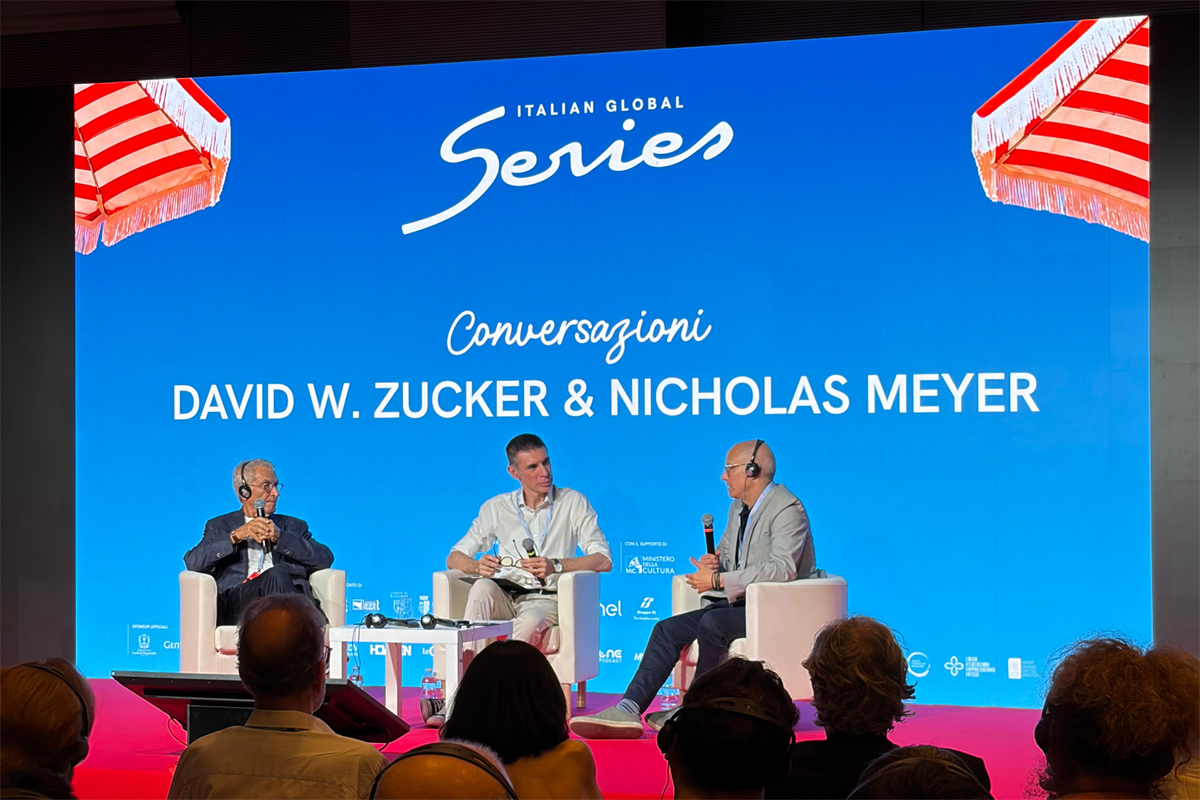

The long industry day of Tuesday, July 7, in Riccione, held as part of the second edition of the Italian Global Series Festival — running in Rimini and Riccione from July 3 to 11 — concluded with one of the most best conversations of the programme. After the cocktail hosted at the Calabria Film Commission space, the audience gathered for a special talk featuring two major figures of international audiovisual storytelling: Nicholas Meyer and David W. Zucker. Moderated by Professor Roy Menarini, the conversation brought together two creators and producers whose careers have crossed some of the most influential territories of cinema and television, from iconic franchises to prestige drama and long-form serial narratives.
Nicholas Meyer is an award-winning writer, director and author whose work has left a significant mark on both film and television. He directed The Day After for ABC in 1983, a landmark television movie that remains one of the most watched TV films in history, with more than 100 million viewers in a single night and fourteen Emmy nominations. His television credits also include the two-part miniseries Houdini (2014), starring Adrien Brody and based on the biography written by his father, Bernard C. Meyer. Meyer is also co-creator of Netflix’s Medici: Masters of Florence, starring Dustin Hoffman, and worked on Star Trek: Discovery for CBS All Access.
David W. Zucker, Chief Creative Officer at Scott Free, has overseen and executive produced a wide range of high-profile international series. His recent credits include Alien: Earth for FX, created by Noah Hawley; the crime drama Dope Thief for Apple, starring Oscar nominees Brian Tyree Henry and Wagner Moura; and the conspiracy thriller Prime Target, also for Apple, starring Leo Woodall. Upcoming projects include Blade Runner 2099 for Amazon, starring Academy Award winner Michelle Yeoh and Hunter Schafer, and the psychological horror series The Terror: Devil in Silver for AMC, with Dan Stevens and Judith Light.
Under Zucker’s creative leadership, Scott Free has built an impressive television slate including seven seasons of The Good Wife for CBS, winner of the Peabody Award and nominated for both Emmy and Golden Globe Awards; six seasons of its acclaimed spin-off The Good Fight for Paramount+; Raised by Wolves for HBO Max; The Man in the High Castle for Amazon; Great Expectations and A Christmas Carol for FX/BBC; Kaleidoscope for Netflix; The Beast Must Die for AMC/BritBox; The Hot Zone and The Hot Zone: Anthrax for National Geographic; Jean-Claude Van Johnson for Amazon; and six seasons of the crime drama Numb3rs for CBS.
A central theme of the conversation was how contemporary television can approach legendary cinematic worlds such as Alien and Blade Runner without simply reproducing or exploiting the original works. For Zucker, the key lies in understanding these titles not only as stories, but as complex universes. Returning to such properties means exploring their worlds, their atmosphere, their philosophical questions and their emotional relevance, while allowing new characters and new narrative directions to emerge.
Speaking about Blade Runner 2099, Zucker suggested that the title itself already reveals something essential about the creative approach. The timeframe, he explained, was carefully considered, because for Ridley Scott it was important to keep the story within a future that still feels connected to the lifespan of people living today. In this sense, even a deeply speculative world must preserve a human bridge with the present. Zucker compared this challenge to the experience of working on The Man in the High Castle, another series built around an alternative world that nevertheless needed to remain emotionally and politically legible to contemporary audiences.
The discussion then broadened to the current state of narrative storytelling. Meyer offered a sharp and provocative reflection on the impact of technology on audience attention. In his view, the mobile phone has radically transformed the way people relate to stories. The constant presence of screens, notifications and fragmented content has changed the audience’s capacity to remain immersed in a long narrative, whether in the form of a feature film or a multi-part series.
Meyer expressed concern about the rise of extremely short forms of storytelling, including vertical formats designed to be watched in just a few minutes. He recalled how Jeffrey Katzenberg’s Quibi, once considered a failed experiment, may simply have arrived too early. What worries him today is not only the compression of narrative into soundbite-like formats, but also the cultural and cognitive consequences of this shift. For a storyteller formed by literature, cinema and television, the risk is that narrative depth may be weakened in favour of faster, more disposable forms of consumption.
Zucker shared part of this concern, while also offering a more hopeful perspective. He observed that among younger professionals there is a growing awareness of what may be lost in a communication culture dominated by messages, emails and short interactions. The fear, he noted, is not only that attention spans are changing, but that people may lose the ability to engage in direct human exchange, including conflict, dialogue and emotional connection. Yet Zucker also suggested that periods of rapid technological disruption often create a counter-movement: the more isolated people become, the more they may feel the need to return to shared experiences.
This point resonated strongly with the atmosphere in the room. The audience at the Riccione event was not made up only of industry veterans, but included many young television fans in their twenties, attentive and engaged throughout the conversation. Their presence seemed to contradict, or at least complicate, the idea that younger generations are no longer interested in long-form storytelling.
Meyer closed with a passionate defence of the collective experience of art. For him, cinema, theatre, ballet and opera retain their power precisely because they bring people together. The experience is at once personal and communal: each spectator lives it individually, yet shares it with strangers in the same space. In an age of fragmented attention and solitary consumption, this collective dimension may be more necessary than ever.
Short-Form Series Will Not Kill Storytelling: Nicholas Meyer and David W. Zucker Defend the Power of Shared Narratives