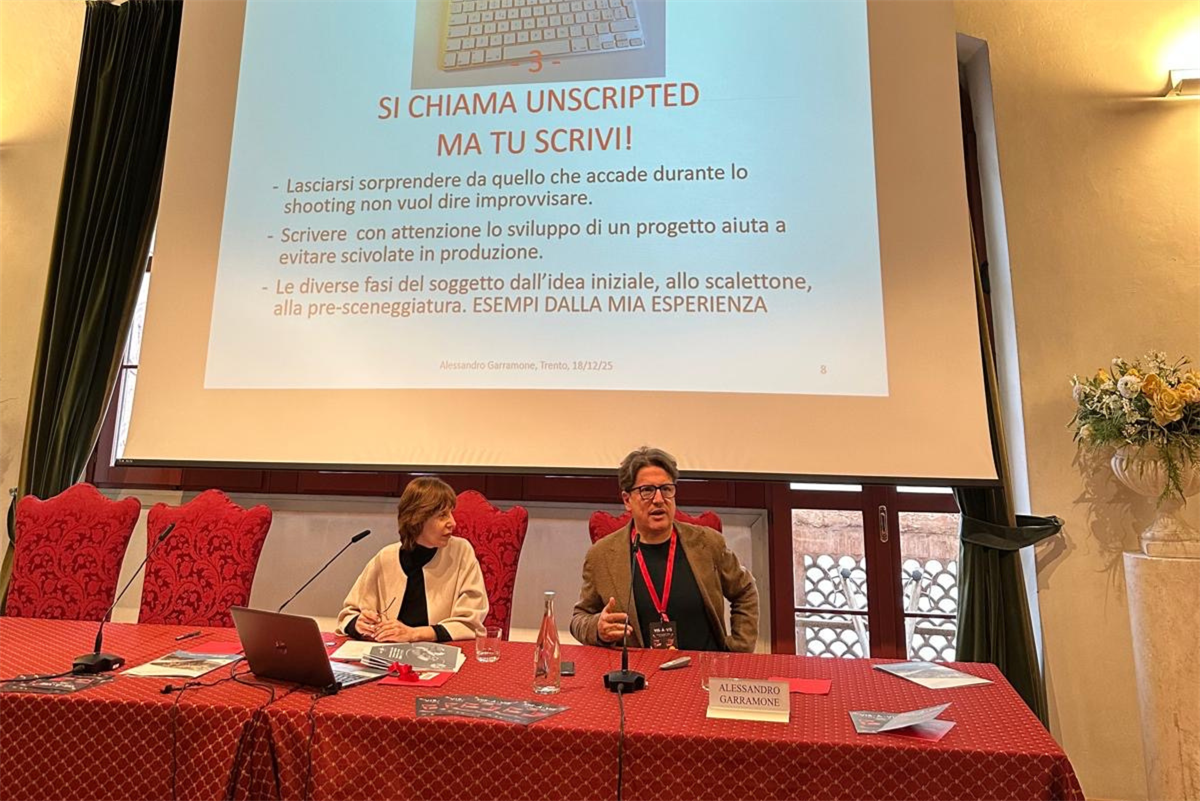

At Vis-à-Vis Trento, the two-day industry event organized by Film Commission Trento (17-18 December, 2025), one of the most concrete and strategically relevant panels focused on the mechanics behind successful documentary series. Led by Alessandro Garramone—journalist, writer, director, and former commissioning executive—the session offered an insider’s view on how nonfiction projects are developed, pitched, written, and delivered in today’s global content market.
Titled “Eight Things I’ve Learned from Documentaries (Mine and Others)”, Garramone’s presentation avoided creative rhetoric in favor of production logic, editorial responsibility, and market awareness—key elements increasingly demanded by international broadcasters and platforms.
Garramone’s background spans investigative journalism, mainstream television authorship, executive commissioning roles, and premium docu-series production. After early work on Rai 3’s Sfide, he authored and supervised content for Rai, Sky, Mediaset, and La7, before moving into executive positions at MTV Italy and Fox Group–owned Wilder.
His creative output includes long-running true crime series (Delitti), platform-driven docu-series such as Wanna for Netflix, and recent projects like Il giovane Berlusconi and Terrazza Sentimento, alongside consultancy on high-end scripted titles. This hybrid profile—creative and industrial—framed the panel’s pragmatic tone.
One of Garramone’s central messages challenged a common development misconception: ideas are abundant, but only a minority are viable. In documentary development, he argued, concept “mortality” is structurally high—and should be accepted as part of the process. Creators must not fall in love with single ideas but trust their ability to generate new ones.
Statistical realism, rather than creative enthusiasm, becomes the first filter. Projects must be stress-tested internally before being exposed to the market, where access constraints, legal issues, and production complexity rapidly eliminate weak concepts
In a market increasingly driven by true stories, Garramone emphasized that access—not subject matter—is the true intellectual property of nonfiction. Producers must be precise about what access they genuinely control, from which narrative point of view, and whether the story exists independently of the shoot itself.
Promising more than what is already secured, he warned, undermines editorial credibility and weakens the pitch in front of commissioners who are now acutely risk-aware.
Unscripted Requires Writing Discipline
Despite the “unscripted” label, Garramone positioned writing as the backbone of any documentary series. Structured development—from initial subject outlines to detailed step outlines and pre-scripts—prevents editorial drift and production inefficiencies.
Using Wanna as a case study, he demonstrated how early written materials shaped the final series long before filming began, reinforcing a model increasingly adopted by platforms seeking narrative consistency and binge-ready storytelling.
Pitching, in Garramone’s view, is an exercise in calibrated communication. Logic and empathy must coexist. Trailers and casting tapes are not ancillary materials but strategic tools that help commissioners visualize tone, access, and sustainability.
When building pitch trailers, storytelling should be prioritized over stylistic ambition. The goal is to stimulate curiosity and highlight narrative tension—reserving full explanation for the verbal pitch itself.
A recurring theme addressed emerging producers directly: creating docu-series without actively watching them is a structural weakness. References are not optional—they function as market intelligence, signaling where audience taste and commissioning strategies are moving.
Garramone drew a clear distinction between episodic documentaries and true docu-series. Horizontal narrative arcs, episode-to-episode propulsion, and binge logic must be embedded at writing stage. Each episode’s ending is designed to trigger the next—mirroring scripted series logic increasingly adopted in premium nonfiction.
The final section focused on production architecture. High-end docu-series operate as complex systems involving legal review, production design, editorial approvals, and layered workflows. Experience matters, and growth must be incremental.
Good intentions alone, Garramone concluded, are insufficient. Professional nonfiction requires structure, patience, and a clear understanding of industrial constraints.
At Vis-à-Vis Trento, Alessandro Garramone delivered not a motivational talk, but a market-facing masterclass. His intervention resonated precisely because it addressed nonfiction storytelling as an industrial practice—where creativity, execution, and strategic awareness must align.
Documentary Series - From Concept to Market Reality – Alessandro Garramone at Vis-à-Vis Trento