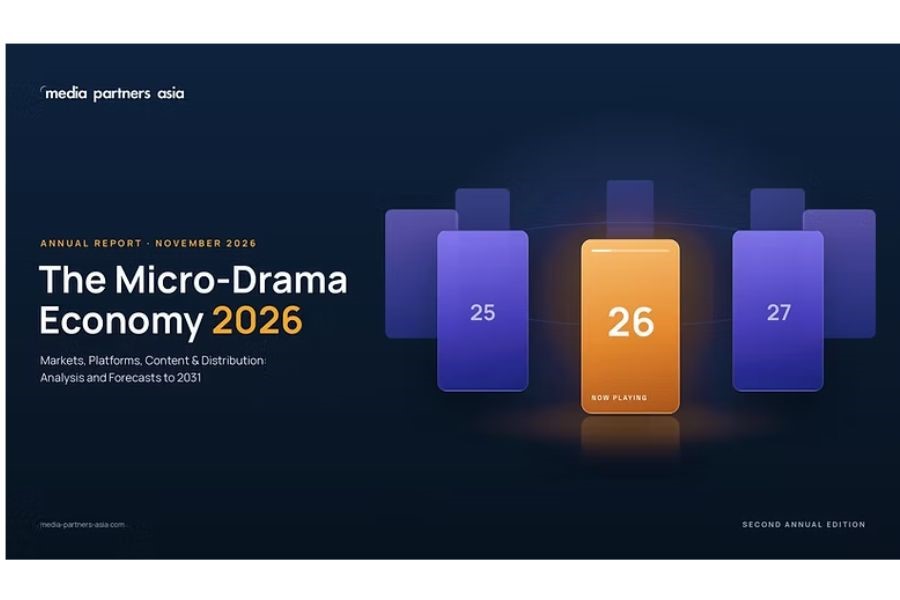

The global microdrama market is expected to generate US$20 billion in revenues in 2026, up 24% year-on-year, and reach US$32 billion by 2031, according to The Micro-Drama Economy 2026, the second annual report published by Media Partners Asia (MPA) on November 26. However, despite growing international demand, profitability remains a major challenge, while artificial intelligence, industry consolidation and emerging distribution models are rapidly reshaping the sector.
China remains the undisputed leader, accounting for 76% of global revenues, with US$15.2 billion in 2026. The Chinese market is projected to reach US$21 billion by 2031, with advertising increasingly driving the business. Advertising-funded services account for 69% of Chinese microdrama revenues in 2026, a figure expected to rise to 79% by 2031.
Outside China, dedicated microdrama platforms are generating US$4.87 billion in 2026, with revenues projected to reach US$11 billion by 2031, representing a compound annual growth rate of 17.7%.
The United States remains the largest individual market outside China, generating US$1.71 billion, despite a 2% year-on-year decline. However, Asia-Pacific, excluding China, is expected to overtake the US by 2029.
India is emerging as one of the industry's most dynamic markets, with revenues more than tripling to US$322 million in 2026, surpassing Japan and South Korea. Local platforms Kuku TV and Story TV have experienced significant growth, while JioStar entered the market in April with Tadka, its dedicated microdrama service on JioHotstar.
Despite the sector's rapid expansion, its economics remain challenging. Outside China, 56 cents of every dollar generated are spent on marketing, while a further 18 cents go to app stores and payment providers. Only around one in twelve users pays in a given month.
DramaBox reported a net profit margin of just 3.2% in 2025, while ReelShort recorded a US$12 million loss in the same year before returning to profitability in the first quarter of 2026, with a profit of approximately US$8 million.
“Demand for micro drama is established in every major market, but outside China this is still an emerging business, and it has yet to show that it can earn a durable profit,” said Vivek Couto, CEO & Executive Director of Media Partners Asia.
“The leading apps spend more than half of their revenue to acquire viewers, and most of those viewers do not pay. Consolidation has begun, and China has already moved to free, advertising-funded viewing. The companies that endure will be those that retain their viewers, bill them directly and invest in titles worth returning to.”
One of the report's most striking findings concerns the exponential growth of AI-generated content.
MPA estimates that new title listings across dedicated microdrama apps outside China have increased from approximately 100,000 in 2025 to 440,000 in 2026. AI-generated productions account for 75% of these listings, compared with just 15% a year earlier.
The figures include multiple language versions and releases of the same title across different platforms, rather than exclusively original productions.
An AI-generated microdrama costs approximately one-tenth of a series filmed in Los Angeles. Nevertheless, audience preferences have not shifted at the same pace: live-action productions continue to dominate the 50 most-viewed titles on five of the six international platforms monitored by MPA.
In China, AI-generated productions account for approximately 90% of titles released in 2026 but generate only 20% of revenues.
“AI has made a title cheap enough to test almost any idea, and catalogues have filled accordingly,” said Myat Pan Phyu, Lead Analyst, Micro Drama & Vertical Video at Media Partners Asia. “Viewing has moved far less: live action still dominates the leading titles on most of the platforms we track.”
The international microdrama market is already highly concentrated, with four Chinese-owned or Chinese-backed groups — ReelShort, DramaBox–GoodShort, Kunlun and NetShort — accounting for 65% of revenues outside China.
The merger between DramaBox and GoodShort, announced on October 31, marks the beginning of consolidation among leading platforms. Meanwhile, established US media groups, including Fox, Versant and NBCUniversal, have entered the sector through minority investments.
TikTok is also emerging as a key player across the entire value chain, combining advertising, content distribution and direct competition through its free microdrama app PineDrama. MPA expects ByteDance to establish a significant presence in both the US and Southeast Asia by 2031.
Their competitive advantages include established intellectual property, recognizable talent, existing audiences and direct customer relationships. Japan's Fuji TV, through FOD SHORT, and South Korea's Vigloo are among the local players competing in a market still largely dominated by Chinese-backed platforms.
Direct billing is also expected to become increasingly important. Apple and Google currently handle 65% of revenues outside China, but alternative payment systems could improve profitability by reducing reliance on app-store commissions. MPA expects payments outside app stores to account for approximately half of international revenue growth in 2027.
Ultimately, the next chapter of the microdrama industry may be defined less by the sheer volume of content produced and more by the ability to develop distinctive IP, retain audiences and establish sustainable business models.
The Micro-Drama Economy 2026 covers nine key markets, drawing on audience measurement across 50 apps in 12 markets, company financial data, consumer research and industry interviews, with forecasts through 2031.
Microdramas Hit $20 Billion in 2026, but Profitability Remains a Challenge Outside China