
Movistar Plus has released the first images of Iruña 97, an original Spanish thriller set during the 1997 San Fermín festival in Pamplona, where a criminal investigation exposes deep divisions within the city.
Produced by Buendía Estudios Bizkaia, the series is created by Natxo López (Perdida, Entrevías) and Marina Parés, based on an original idea by López. The screenplay is co-written by López, Parés and David Pérez Sañudo, who also directs the series. Parés and Pérez Sañudo previously received the Goya Award for Best Adapted Screenplay for Ane.
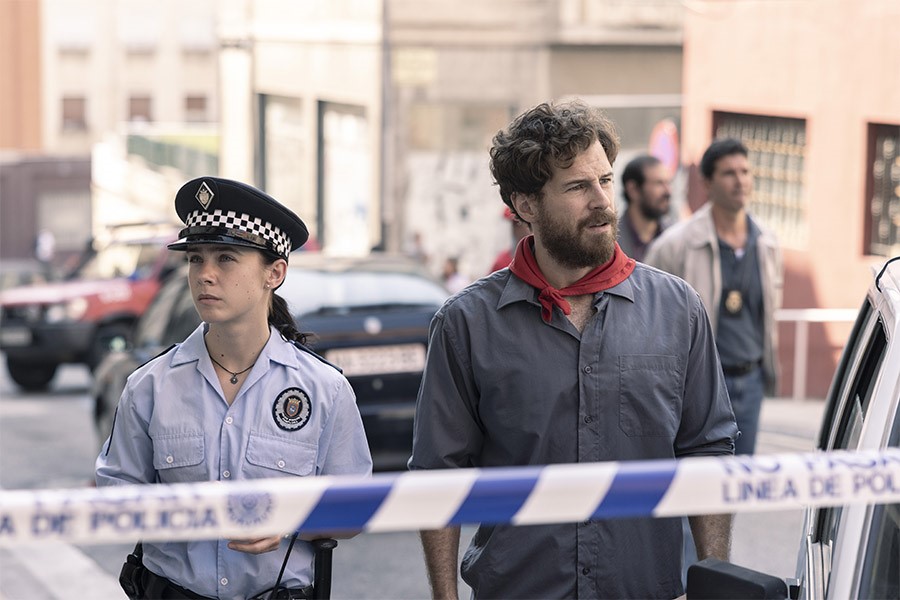
The 15-week shoot has recently wrapped after filming in Vizcaya, Pamplona and southern France. Iruña 97 stars Clara Galle (Olympo, Ni una más) as Amaia, a young municipal police officer, and Álvaro Cervantes (Ane, Sorda) as Julio, a National Police inspector specialising in homicide investigations. The story follows the unlikely partnership between the two officers as they investigate a suspicious death during the San Fermín celebrations. The cast also includes Iñigo de la Iglesia, Pablo Gómez-Pando, Karra Elejalde, María Pujalte, Patxi Freytez, Josu Iriarte, Josean Bengoetxea, Itsaso Arana, Fernando Albizu, Ainhoa Santamaría, Miriam Rubio and Paula Usero, among others.
Synopsis
Pamplona, 1997. An unidentified body is found at the foot of the city walls during the San Fermín festivities. Authorities dismiss the death as a typical festival accident, but Amaia (Clara Galle), a young municipal police officer, suspects murder. Going against her superiors' orders, she brings in Julio (Álvaro Cervantes), a National Police homicide inspector who has recently returned to Pamplona. Despite their differences – she is a Basque-speaking municipal officer, while he comes from a privileged background – the two join forces to investigate a case that proves far more complex than expected. Their investigation unfolds in a deeply divided city, where the euphoria of the festivities coexists with the threat of terrorism. The story takes place in the year when the kidnapping and murder of Miguel Ángel Blanco became a turning point in Spanish society.
Movistar Plus Takes Viewers Into a 1997 Murder Investigation With Iruña 97