

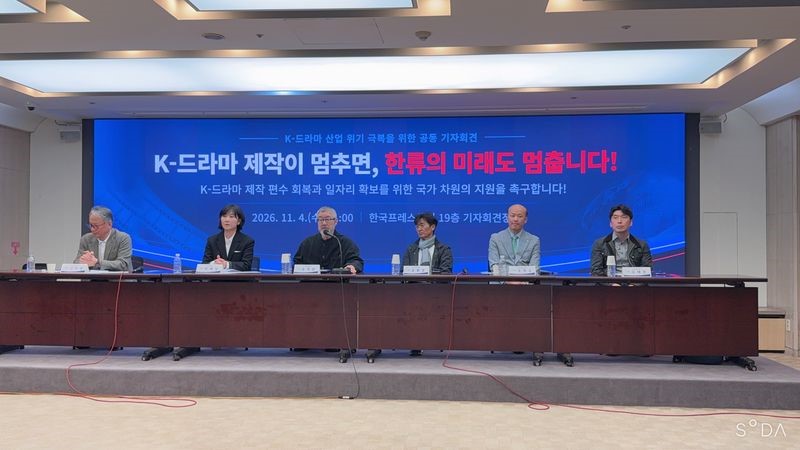
Despite the worldwide popularity of Korean dramas, South Korea's domestic television production industry is facing a serious crisis, marked by declining output, rising production costs and growing concerns over intellectual property rights.Twelve South Korean industry associations, representing drama producers, broadcasters, writers, directors, actors and production crews, have issued a joint warning about the future of the country's drama industry, calling for urgent government intervention.
According to reports published by Reuters and Yonhap News Agency on November 4, representatives of the twelve associations held a joint press conference at the Korea Press Center in Seoul, warning that the domestic production ecosystem is at risk of collapse despite the international success of K-content.The figures highlight the growing difficulties facing the sector. Korean drama production has declined by approximately 30% compared with 2022 levels, when 141 titles were produced. Meanwhile, South Korea's three major terrestrial broadcasters — KBS, MBC and SBS — reduced their drama output from 91 titles in 2012 to just 32 in 2023.
The associations attribute the crisis to soaring production costs, declining advertising revenues, reduced investment from traditional broadcasters and the increasing influence of global streaming platforms, particularly Netflix. A central issue is intellectual property ownership and revenue sharing. While Korean dramas continue to attract international audiences, local producers often struggle to retain IP rights and benefit from the long-term commercial success of their productions.Song Byeong-joon, chairman of the Korea Drama Production Association, called for a more sustainable business model, including greater participation by Korean producers in the revenues generated by global streaming platforms.
To address the crisis, the 12 associations are urging the South Korean government to establish a KRW 1 trillion ($746 million) investment and support programme over five years, equivalent to KRW 200 billion annually.The proposal would help finance approximately 40 medium- and lower-budget drama productions each year, with the government covering half of the estimated production costs and broadcasters and streaming platforms contributing the remainder.
Industry representatives also warned that the reduction in production volumes is threatening employment opportunities for writers, actors and technical crews, potentially weakening the creative talent pipeline that has helped make Korean drama a global phenomenon.
The warning comes as South Korea continues to strengthen its position as one of the world's most influential exporters of scripted entertainment.
However, the associations argue that international success alone cannot guarantee the sustainability of the domestic production industry without structural reforms, stronger investment and fairer distribution of IP revenues.The crisis also raises a broader question for the international television business: how can local production companies remain financially sustainable when global platforms increasingly dominate content financing and distribution?