

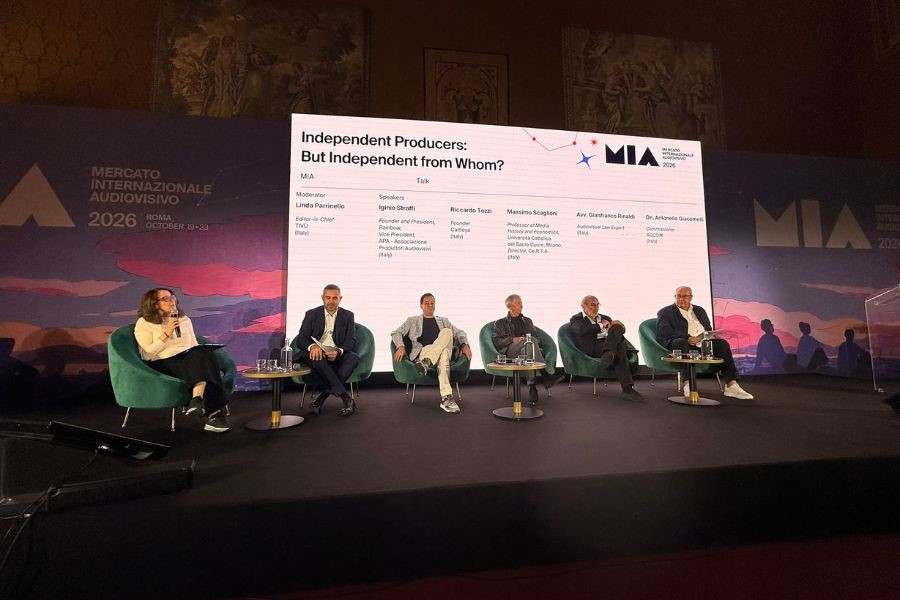
The session explored a crucial issue for Europe's production sector: while investment in original content continues to grow, independent producers are increasingly struggling to retain control of the intellectual property they create and, more importantly, to generate revenues from its exploitation.
Italy: Ownership Does Not Always Mean Control
One of the most significant findings presented during the panel concerned the Italian television production market. According to data from the Italian Public Register of Cinematographic and Audiovisual Works (PRCA), covering 245 Italian television series produced between 2020 and 2024, 68.1% of registered IP ownership was held by producers, compared with 31.9% by audiovisual media service providers.
However, these figures tell only part of the story.
Even when producers formally retain ownership, contractual arrangements may grant broadcasters or platforms extensive exclusive exploitation rights. Long licensing periods, territorial restrictions, holdbacks and contractual options can significantly limit producers' ability to commercialise their content independently.
Another critical finding concerned the structure of the Italian market. More than 50% of spending on Italian scripted series between 2020 and 2025 went to productions made by independent companies controlled by foreign groups, highlighting the distinction between regulatory independence and actual corporate autonomy.
Iginio Straffi stated: “A truly independent producer must be one who retains ownership of the rights. If you give up those rights, you are essentially just an executive producer taking advantage of legislation that provides access to public funding. In fact, foreign groups often grant considerable autonomy to their Italian subsidiaries, meaning that the rights remain with the Italian companies, which record them as assets on their balance sheets.”Italy's regulatory framework nevertheless provides some protection. The tax credit system for television and web productions links access to incentives, in part, to the retention of specific rights by producers.
Spain: A Production Boom Without IP RevenuesThe Spanish case offered one of the most striking comparisons.
Spain has become one of Europe's leading scripted production hubs, with global streamers investing approximately €2 billion in films and original series in 2024, accounting for almost 70% of the country's audiovisual expenditure.
Yet the expansion of production has not necessarily translated into stronger intellectual property ownership or long-term revenues for independent companies.
Research presented during the session, based on responses from 30 companies associated with PATE, revealed that 80% of respondents generated no more than 10% of their revenues from rights exploitation.
The findings also showed that, in projects financed by major broadcasters or platforms, 66.7% of respondents reported arrangements in which all rights were transferred to the commissioning company. Only 3.3% reported retaining significant rights.
Furthermore, 60% of respondents said retaining IP had become more difficult over the past decade, compared with just 13.3% who considered it easier.
The Spanish experience demonstrates how strong investment levels can coexist with limited opportunities for independent producers to build valuable IP portfolios.
Different European Models, Similar Challenges
The panel also examined the regulatory approaches adopted across Europe.In France, streaming platforms are required to invest between 20% and 25% of revenues generated in the country in French or European works. The framework also includes protections designed to prevent platforms from holding certain commercial exploitation rights indefinitely. Germany is considering reforms that would link investment obligations more closely to independent production and the return of rights to producers. Spain requires major private audiovisual operators to allocate a proportion of revenues to European production, but its investment obligations do not automatically guarantee IP retention. The Czech Republic, meanwhile, has introduced an audiovisual funding mechanism supported by contributions from video-on-demand operators, with selective funding arrangements encouraging producers to retain rights and revenue participation.
These different approaches illustrate the growing importance of combining investment obligations with meaningful opportunities for producers to exploit their intellectual property.
The conclusions presented at MIA highlighted four priorities for the European audiovisual industry: connecting investment obligations to the return of rights, linking fiscal incentives to meaningful IP retention, supporting European series and international co-productions, and improving data collection on ownership and the use of public incentives. Ultimately, the challenge lies in developing the right tools and mechanisms to support the growth and long-term sustainability of the Italian audiovisual industry.