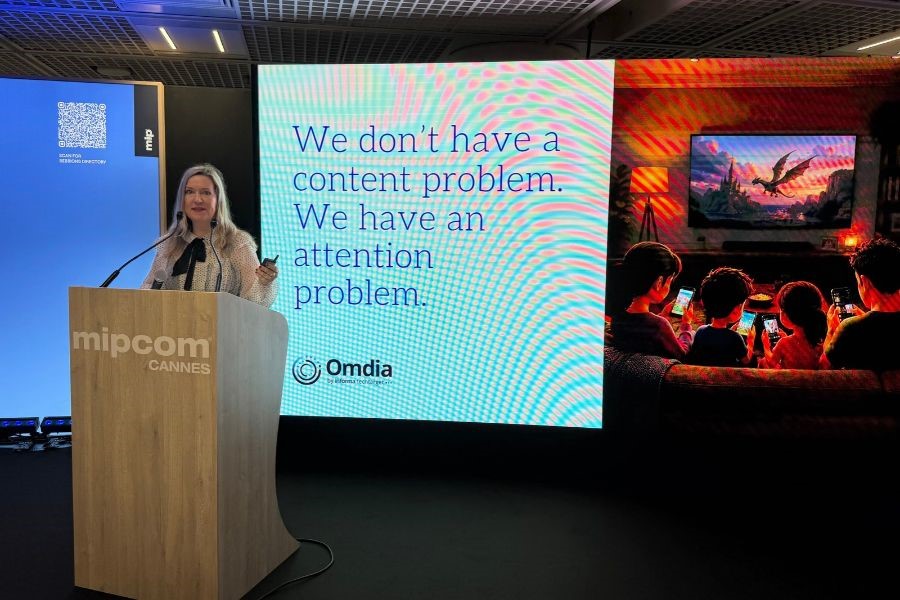

I owe an apology to María Rúa Aguete, Head of Media & Entertainment at Omdia. During MIPCOM Cannes 2026, I barely had the chance to catch up with her. But I have a good excuse: she was incredibly busy, moving from one conference to another, presenting new research and sharing fascinating insights into a subject that has clearly become one of her greatest passions: microdramas.
I have been following María's work for many years, and I can safely say that few industry analysts are as enthusiastic about this rapidly evolving entertainment phenomenon as she is. In fact, we have affectionately started calling her our very own “Lady Boss”, borrowing the expression from the endless stream of billionaire romances, powerful CEOs and dominant female characters that populate our mobile screens.
And, like a true Lady Boss, María arrived in Cannes ready to challenge some deeply rooted assumptions about the industry.
One of the most surprising findings she highlighted during MIPCOM concerns the audience itself. For years, microdramas have been associated almost exclusively with female viewers, particularly those attracted to romantic stories featuring handsome billionaires, secret marriages, betrayal, revenge and dramatic love triangles.
But what if the industry has been looking at only half the picture?
According to new Omdia research released on October 13, men account for 54% of microdrama users in the UK, making them the majority of the audience in that market. And the UK is not an isolated case. Omdia Consumer Research, conducted in April 2026, reveals that men represent 47% of microdrama users across the markets surveyed. In the United States, the audience is evenly divided between men and women, while in Spain, men account for 47% of users. Brazil presents a different picture, with women still dominating at 71%. These figures challenge one of the most persistent stereotypes surrounding vertical storytelling.
“Everyone talks about microdramas as entertainment for women. But our research tells a very different story,” said María Rúa Aguete, Head of Media & Entertainment at Omdia". “Producers and platforms may be underestimating the potential audience for microdramas and how broadly the format can appeal. Nearly half of microdrama users are men. In the UK, men are actually the majority. This finding challenges the industry's longstanding association of microdramas with romance and content aimed at women.”
This is a new opportunity for producers and the implications for the international television industry are significant. Until recently, much of the microdrama business has been driven by romantic narratives, often following highly recognizable storytelling formulas: the billionaire who falls in love with an ordinary girl, the rejected wife who returns for revenge, or the seemingly powerless heroine who turns out to be secretly wealthy.
These stories have helped establish the commercial appeal of vertical drama, particularly through mobile-first platforms and their distinctive monetization models.
But if men represent such a substantial share of the audience, should producers and commissioners begin rethinking their content strategies?
The answer may lie in genre diversification. Crime, action, thrillers, comedy and suspense could offer new opportunities for platforms seeking to expand their audiences and increase engagement. Rather than abandoning romance, the industry may need to recognize that the format has the potential to accommodate a much wider range of storytelling.
According to Omdia, microdrama revenues are expected to reach approximately $14 billion in 2026, rising to nearly $25 billion by 2031, as the industry continues to grow beyond its original stronghold in China. These are figures that traditional broadcasters, international distributors, production companies and streaming platforms can hardly afford to ignore. However, the real challenge is no longer simply producing more short episodes or replicating the formulas that have already proved successful. It is about understanding who is watching, why they are watching and what kind of stories can attract new audiences.
“The next phase of microdrama growth will not simply be about producing more episodes or attracting more women. It will be about understanding different audiences, experimenting with genres and recognizing that short-form storytelling is not a niche format. It is becoming a mainstream entertainment category,” concluded Rúa Aguete. For those of us who have spent decades following the international formats business, this is perhaps the most interesting part of the microdrama revolution.
We have seen countless new trends emerge, explode and sometimes disappear. But vertical storytelling is raising questions that go far beyond the length of an episode or the orientation of a screen. It is challenging the traditional relationship between storytelling, audience behaviour, distribution and monetization.
And María Rúa Aguete's latest research reminds us of something fundamental: never assume you know your audience simply because you think you know the genre. Perhaps the next global microdrama hit will not feature a billionaire CEO rescuing his secret wife. Perhaps it will be a crime thriller, an action series or a comedy designed for an audience that the industry has not yet fully understood.
So, María, please accept my apologies for not managing to catch up properly in Cannes. But thank you for giving us another reason to look more closely at a business that is evolving faster than many of us could have imagined.
(MCD)
Omdia’s “Lady Boss” María Rúa Aguete Reveals the Men Behind the Microdrama Boom