
Microdrama has moved from an emerging trend to one of the most discussed topics at MIPCOM Cannes 2026. But behind the rapid growth of vertical content lies a complex business ecosystem that operates very differently from traditional television distribution.
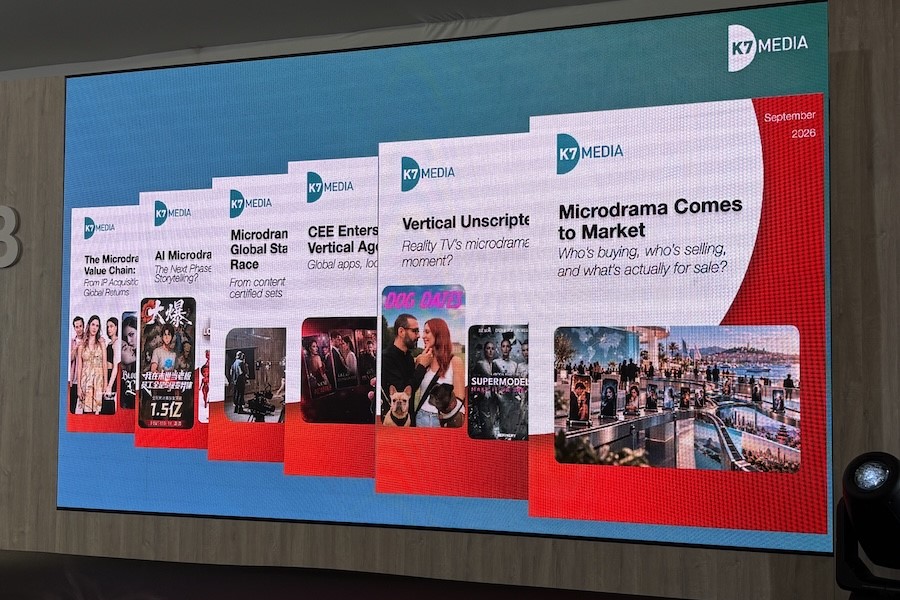
During the session “Who’s Buying Vertical? Inside Microdrama’s Emerging Distribution Market”, held at the MIP Creative Hub on Thursday, October 15, Clare Thompson, Non-Executive Director at K7 Media, presented key findings from the company's latest research into the global microdrama industry. Just one year after K7 Media's first MIPCOM presentation on the subject, the conversation has shifted significantly. The question is no longer what microdrama is, but who is buying it, who is selling it, and how the industry can generate sustainable revenues.
Global Growth: Audiences and Revenues Tell Different Stories
According to figures presented by K7 Media, China remains the world's largest microdrama market, with approximately 662 million users, while India has rapidly reached 100 million monthly active users and 450 million downloads in a year. However, the United States remains the most lucrative market outside China. In the first quarter of 2025, short-drama apps generated approximately $350 million in US in-app revenue, representing 49% of the global total cited in the research. Download figures reveal a different picture. Latin America recorded nearly 100 million downloads during the same period, followed by Southeast Asia with 87 million, compared with approximately 30 million in the US. According to Omdia, the US registered 66 million monthly active users in 2025, followed by Brazil (24 million), Mexico (20 million), the UK (8.2 million) and Germany (4.4 million). Yet revenue rankings outside China tell another story, with the US followed by Japan, South Korea, the UK and Thailand. The key takeaway is that audience reach and monetisation do not necessarily go hand in hand.
Vertical Is a Format, Microdrama Is a Business Model
One of Thompson's central messages was the distinction between vertical storytelling and microdrama as a commercial model. "Vertical is a format. Microdrama is a business model. They are not necessarily the same thing." K7 Media identified three parallel business models currently shaping the industry. The first is app-gated microdrama, represented by platforms such as ReelShort, DramaBox and NetShort, where viewers pay through subscriptions, virtual coins or episode unlocking. The second is platform-native vertical storytelling, distributed free on TikTok, YouTube and Instagram and supported by advertising, sponsorship and branded content. The third involves broadcasters and streamers using vertical series to attract younger audiences, extend existing IP, increase engagement and drive viewers towards their platforms. While all three share the same vertical format, their commercial objectives are fundamentally different.
Low Production Costs, High Marketing Investment
A typical US vertical drama costs between $150,000 and $300,000 to produce, often with shooting schedules of just eight to ten days. However, production is only a small part of the overall investment. According to K7 Media, marketing expenditure for leading microdrama apps can exceed production budgets by as much as nine times. The business model relies on attracting audiences through free introductory episodes, usually seven to ten, before converting viewers into paying customers. For producers, this means the commercial value of a series depends not only on its storytelling but also on its ability to attract users, generate conversions and maintain engagement.
New Distribution Opportunities
As the industry matures, microdrama is beginning to adopt some of the distribution structures familiar to traditional television. Alongside commissioned productions and work-for-hire agreements, new co-financing models allow producers to retain rights and exploit their content across multiple platforms. Thompson highlighted an illustrative UK business plan involving first-window licensing agreements with three to six platforms, generating approximately £20,000–£50,000 per title per platform. Another proposed model involved a $120,000 upfront exclusive agreement, production-related financial guarantees, a 50% revenue share and rights reverting after twelve months. These examples are not standard market rates, but they demonstrate the emerging opportunities for independent producers willing to take greater financial risks in exchange for retaining ownership of their IP. However, distribution windows are becoming increasingly short. In some cases, the initial exclusive window lasts just two weeks before a title moves to other platforms.
ReelShort Leads a Concentrated Market
K7 Media also examined the economics of ReelShort, which holds an estimated 29% share of the microdrama market outside China, according to Media Partners Asia. DramaBox follows with 21%, DramaWave with 13%, NetShort with 10% and GoodShort with 6%. ReelShort's estimated revenues are projected to increase from $785 million in 2025 to $1.05 billion in 2026, reaching $1.7 billion by 2028. Media Partners Asia also forecasts approximately $63 million in EBITDA and $40 million in net profit for 2026, with EBITDA potentially reaching $306 million by 2028. A key factor behind this expected profitability is the reduction in marketing expenditure as a share of revenue, from 55% in 2025 to a projected 44% in 2028. These figures are industry estimates rather than financial results officially published by ReelShort.
From App Growth to an International Rights Market
The central question emerging from K7 Media's presentation is whether microdrama can evolve from an app-driven acquisition business into a more structured international market for content rights. For producers, distributors and broadcasters, opportunities are expanding, but success requires new strategies, faster production cycles, flexible licensing agreements and a deeper understanding of digital monetisation. As highlighted at MIPCOM Cannes, microdrama is no longer simply a shorter version of television drama. It is a distinct commercial ecosystem, increasingly reshaping how content is produced, marketed, distributed and monetised worldwide.
K7's Non-Executive Director Clare Thompson Explores the Evolving Global Microdrama Market at MIPCOM Cannes