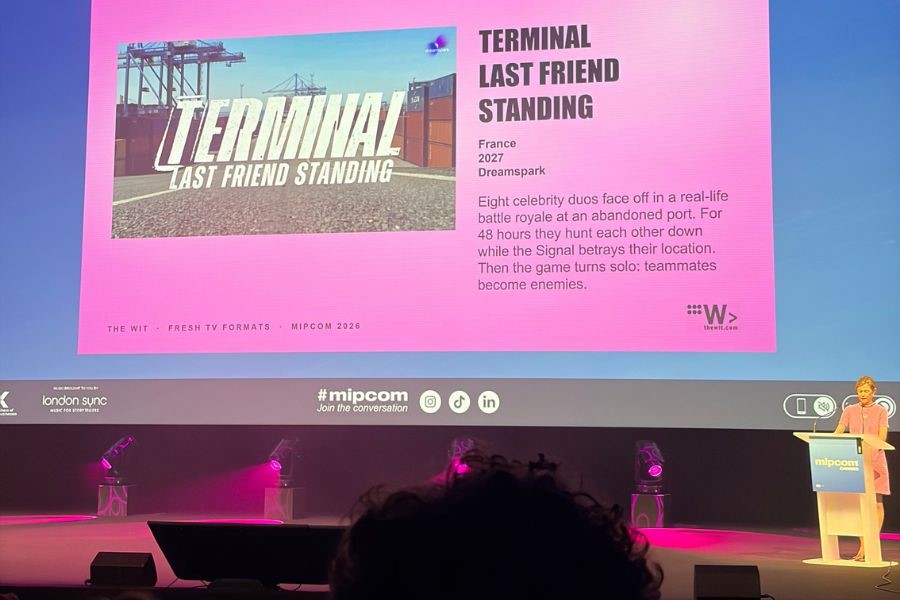

Are television formats dead? It may sound like a provocative question, particularly at MIPCOM, where the international format business has traditionally celebrated creativity, innovation and the next big global hit. Yet it was precisely the question that came to mind after attending Virginia Mouseler’s highly anticipated Fresh TV Formats presentation on Monday, 12 October.
As always, the CEO of The Wit was welcomed like a star at the Grand Auditorium of the Palais des Festivals. Her annual presentation remains one of the most eagerly awaited appointments at MIPCOM, offering a fascinating snapshot of the ideas, trends and programmes shaping the global television industry.
But behind the excitement, the figures presented a much less optimistic picture.
A Format Industry in Depression?
According to The Wit, the number of new formats securing at least one international option within 12 months has fallen by 62%, from 84 in 2013–2014 to just 32 in 2024–2025.
The decline is particularly striking in the UK, historically one of the world’s most influential format exporters. The number of new British formats travelling internationally dropped from 24 in 2019 to just nine in 2025, a fall of 63%.
The situation becomes even more alarming when looking at international hits. The number of formats achieving at least three adaptations fell from 64 to just nine between 2015 and 2025, according to The Wit’s analysis.
Meanwhile, new adaptations of recently launched formats are down 40% compared with 2018–2019, while additional seasons of established formats have increased by 15% over the same period.
Even the most recent figures suggest continued weakness: total adaptations declined by 8% year-on-year, with new formats falling by 16% and returning seasons by 4%.
These numbers do not mean that audiences have stopped watching entertainment formats, or that the entire television production industry is shrinking at the same rate. They do, however, point to a serious contraction in the international circulation of new ideas.
Can we call it a depression? Perhaps not in strictly economic terms, but certainly a crisis of confidence in originality.
One of the clearest messages emerging from the presentation was the industry’s increasing dependence on established brands.Broadcasters and streamers appear more comfortable investing in familiar formats, renewing successful franchises and commissioning additional seasons than taking risks on untested concepts.
The Traitors, The Floor, Taskmaster and The Box continue to demonstrate the international strength of proven entertainment properties. Over the past 12 months, The A Talks led the ranking with eight new versions, followed by The Traitors with seven, The Floor with six, and The Nation’s Dumbest with five.
Interestingly, the few formats that do break through internationally are travelling faster. According to The Wit, the average time required to reach a third adaptation has fallen from 737 to 370 days.
In other words, there are fewer international hits, but successful concepts can now spread much more rapidly.
The paradox is clear: the market still needs new ideas, but seems increasingly reluctant to take the risks necessary to discover them.
Are Content Creators the New Format Developers?
Perhaps the most revealing part of Mouseler’s presentation concerned the growing influence of YouTube creators and digital-native entertainment. For decades, the format industry operated through a relatively established creative ecosystem: producers developed concepts, broadcasters commissioned programmes, distributors acquired rights, and international adaptations followed.
Today, that model is being challenged.
New entertainment ideas are increasingly emerging from YouTube, social platforms and creator communities, where concepts can be tested directly with millions of viewers before attracting the attention of traditional television executives.
The Wit analysed 5,935 successful YouTube videos published between 31 August and 6 October 2026, identifying recurring entertainment mechanisms that could inspire future television formats.
Videos built around doors, escape routes and progressive challenges generated 75 million views across seven videos in five weeks. Content connected to the Backrooms universe of creator Fede Vigevani reached 206 million views across seven episodes.
Meanwhile, confinement, escape and last-person-standing challenges generated 230 million views across 40 videos, although one MrBeast video accounted for 120 million of those views.
The figures are impressive, even if online views cannot be directly compared with television ratings.
More importantly, they suggest that creators are becoming an increasingly influential source of entertainment IP.
Mouseler’s message was almost a new development formula: identify a successful creator concept, expand it for another platform, and transform proven online engagement into a television proposition.
Old Formats, New Creators
There is another emerging trend that deserves attention: the revival of established television formats through the creative language of digital creators.
Rather than inventing entirely new concepts, the industry is looking at how familiar entertainment mechanics can be reinterpreted on YouTube, combined with celebrities and creators, and transformed into large-scale live events.
This approach raises an interesting question about the future of originality.
Are creators genuinely inventing a new generation of formats, or simply reinventing television concepts that have existed for decades?
Challenges, hidden identities, elimination games, survival competitions and social experiments are hardly new ideas. What has changed is the pace, storytelling, visual language and direct relationship with audiences.
The creator economy has introduced a different way of developing entertainment: faster, more experimental and driven by immediate audience feedback.
Traditional television, by contrast, often requires longer development cycles, higher budgets and multiple layers of approval.
Despite the worrying statistics, Mouseler’s presentation also featured a diverse selection of new concepts.
Among them was 100 Doors, a French entertainment concept from Dreamspark in which ten celebrities navigate an arena featuring one hundred numbered doors, each potentially hiding challenges, clues or elimination, with only one leading to the exit.
Japan’s Switch, from TV Asahi, offers a comedy competition in which eight comedians must alternate between delivering jokes and reacting to them, testing their improvisational abilities.
In Belgium, My Granfluencer brings together three content creators and three seniors, challenging them to become Instagram influencers over five weeks. The project illustrates how social media culture can become the central narrative engine of a format rather than simply a promotional extension.
Other examples include The Master Guide, in which celebrities compete to become museum guides, and The Sweetest Revenge in the World, a vertical microseries extending the universe of an established television quiz.
These concepts demonstrate that creativity has not disappeared. But they also reflect a market increasingly attracted to instantly understandable mechanics, recognisable personalities, digital engagement and existing IP.
Are TV Formats Dead? The Industry Faces an Identity Crisis at MIPCOM 2026