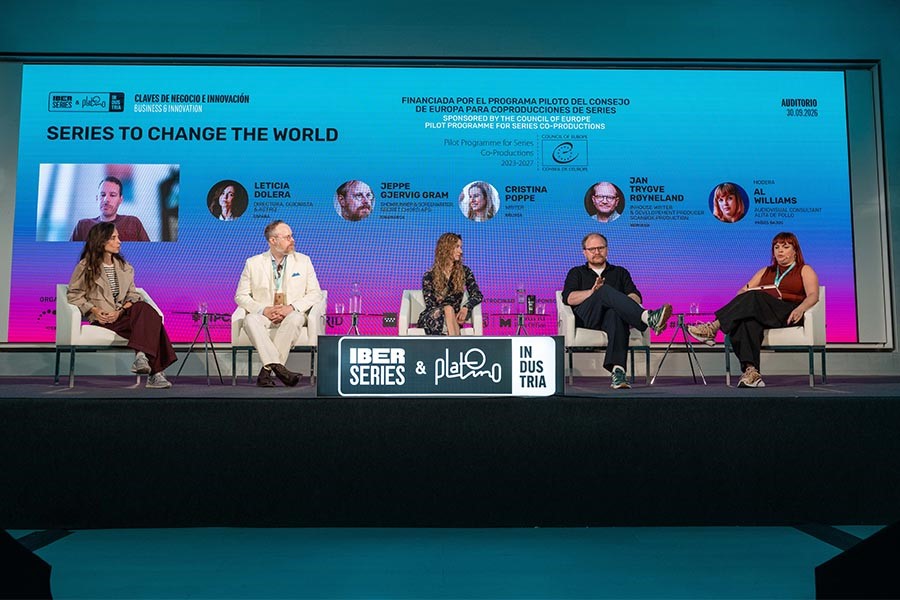

The second day of Iberseries & Platino Industria 2026 focused on the power of stories to generate empathy and debate, while examining how the audiovisual industry is adapting to new consumption habits, production models and international opportunities. Series addressing major social issues were at the centre of several discussions. At the panel “Series to Change the World”, creators including Louis Aubert, Leticia Dolera, Jeppe Gjervig Gram, Cristina Poppe and Jan Trygve Royneland discussed how fiction can encourage conversations around climate change, sexuality, politics, immigration and social injustice.
For Belgian screenwriter Cristina Poppe, “I don’t believe that series and films change the world, but they can generate empathy, tell stories about people who are having a hard time and open up debates.” Atresmedia Managing Director José Antonio Antón also highlighted adaptability as a key factor in navigating the transformation of the audiovisual sector. He pointed to the importance of combining the company’s own channels with strategic alliances and stressed the value of continuously developing intellectual property.
European co-production was another major theme, with industry representatives from Secuoya Studios, Beta Film, Quad Drama, Submarine and Atlantique Productions discussing how collaboration across territories can strengthen the international reach of content. Peter Lohner, SVP Hispanic Acquisitions & Co-productions at Beta Film, argued that “a European identity” can be built through stories that attract audiences across different countries, languages and production markets, “having a voice of our own in an increasingly competitive global market”.
The event also marked the beginning of celebrations for the 30th anniversary of the Ibero-American Federation of Film and Audiovisual Producers (FIPCA). The federation highlighted the circulation of Ibero-American works, professional training and stronger industry alliances among its priorities for the years ahead. FIPCA president Ignacio Rey pointed to the challenge of increasing regional circulation, noting: “Generally speaking, there is an economic gap in our films; when we sell them, it is easier to sell them in Europe than in our own region.”
The second day also featured new fiction and non-fiction projects. Secuoya Studios presented El laberinto de las mariposas, an eight-episode romantic thriller starring Can Yaman, while RTVE previewed Rojo sobre blanco and Rocío. Netflix, meanwhile, presented the adaptation of true crime podcast Criminopatía, with creator and host Clara Tiscar discussing the challenge of translating a format built around voice into an audiovisual production.
Microdrama was another key topic, with industry executives discussing the rise of vertical content, fragmented attention and new production dynamics. Lorena Quevedo of Twins Latin Films | Río Ancho Films described the experience of producing a first microdrama for ReelShort as a learning process, emphasizing that “it is not only a change of format or moving from thinking horizontally to vertically, but also in terms of language, because it is a completely different language”. Javier Williams, SVP Spanish Language Content at 3Pas Studios and CEO of Visceral, pointed to changing viewing habits as a major driver behind the format’s growth. “What we are seeing is a paradigm shift in how people are consuming, this fragmentation of attention,” he said.
The day also included presentations from production companies including Globomedia, 100 Balas, Big Bang Media, Cimarrón and El Terrat, highlighting the importance of original IP, talent development, genre diversity and international collaboration. Across its different sessions, the second day of Iberseries & Platino Industria placed storytelling, new formats, co-production and the circulation of Ibero-American content at the centre of the industry discussion.
Iberseries & Platino Industria Explores New Stories, Formats and Industry Strategies