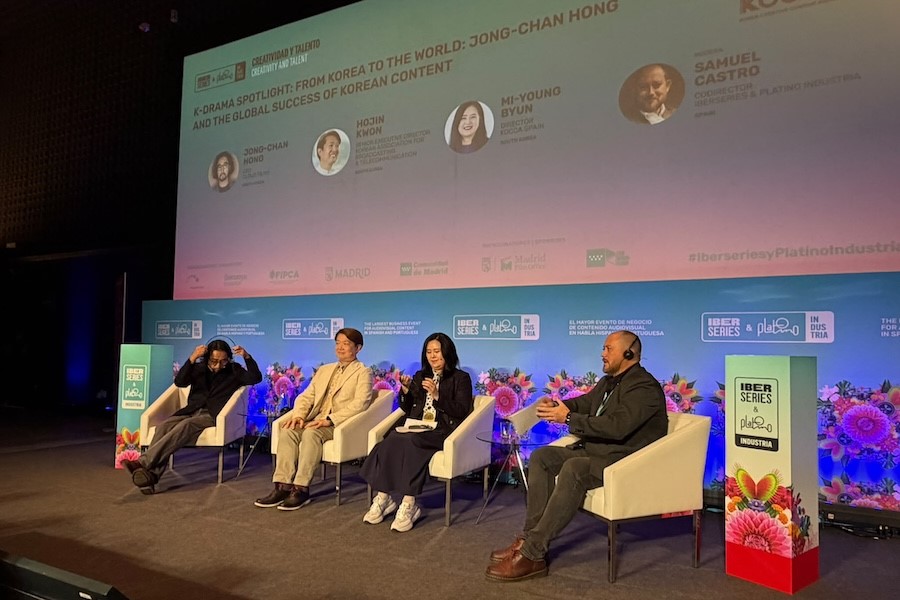

One of the key themes emerging from Iberseries & Platino Industria 2026 in Madrid is that a story does not necessarily need to become less local in order to travel internationally.
That idea was at the heart of the session “K-DRAMA Spotlight: From Korea to the World: Hong Jong-chan and the Global Success of Korean Content,” which explored how distinctly Korean stories can connect with audiences far beyond their country of origin.
The panel brought together Hong Jong-chan, Director & CEO of Cloud Films; Hojin Kwon, Head of Department at SBS; and Miyoung Byoun, Director at KOCCA, with Samuel Castro, President of Fundación Secuoya, Board Member for Internationalisation at the Madrid Audiovisual Cluster and Co-Director of Iberseries & Platino Industria, moderating the conversation.
At the centre of the discussion was a simple but increasingly relevant principle for the international content business: local specificity and global appeal are not opposites. Cultural contexts, social structures and everyday realities may differ significantly from one country to another, but audiences often share the same emotions, concerns and human values. Fear, injustice, frustration, family relationships, the instinct to protect others and the desire to be heard can cross cultural and linguistic boundaries. It is precisely this combination, an authentic local world built around recognisable human emotions, that can transform a domestic story into an international hit.
Teach You a Lesson: a Korean story that travelled globally
Among the titles presented during the session was Netflix’s Teach You a Lesson, directed by Hong Jong-chan, which offers a particularly strong example of that approach. The 10-episode Korean series, released globally on Netflix on June 5, 2026, is based on the webtoon Get Schooled. It is set within a fictional South Korean education system facing growing tensions around school violence, bullying, conflicts between teachers and parents and the erosion of authority in the classroom.
At the centre of the story is the Educational Rights Protection Bureau, a fictional government agency whose inspectors are dispatched to troubled schools when conventional solutions are no longer working. The series follows Na Hwa-jin, played by Kim Moo-yul, alongside Choi Gang-seok (Lee Sung-min), Im Han-rim (Jin Ki-joo) and Bong Geun-dae (Pyo Ji-hoon). Using unconventional and often highly physical methods, the team intervenes in cases involving bullying, school gangs, drugs, academic pressure and conflicts between students, teachers and parents. The premise is unmistakably rooted in South Korea. Its educational structures, institutional framework and social tensions emerge from a very specific national environment. Yet the emotions behind those conflicts are far less specific.
Problems involving the relationship between parents, children and teachers, the vulnerability of victims, the abuse of authority and the search for justice can be recognised by viewers in very different societies. And the international response demonstrates how far that connection can travel. Following its launch, Teach You a Lesson reached No. 1 on Netflix’s Global Top 10 Non-English TV list and remained there for two consecutive weeks. By June 17, the series had entered the Top 10 in 91 countries, including the United States, the United Kingdom, India, France, Germany, Australia, Mexico and Brazil, recording 21.1 million views during the week.
Authenticity rather than standardisation
That response captures one of the most interesting lessons from the Iberseries session. For producers developing content for an increasingly international market, the instinct can sometimes be to make stories more neutral, more universal or less culturally specific in the hope of improving their ability to travel. The Korean experience suggests another route. A story can remain deeply rooted in its own culture while addressing emotions and conflicts that viewers recognise everywhere. The international success of Teach You a Lesson therefore offers a useful case study: global storytelling does not necessarily mean creating a story that could come from anywhere. Sometimes the opposite is true. A story can come from a very precise place, reflect a specific society and speak its own cultural language — and still connect with millions of viewers around the world because the emotions underneath it are universal. Different cultures may tell stories differently. But the feelings and human values behind those stories can be remarkably similar. And in today’s global content market, that shared emotional language may be one of the strongest bridges between local authenticity and international success.
How Local Stories Can Become Global Hits: The Case of Netflix’s Teach You a Lesson