
We are back from the summer holidays, and I have immediately fallen into the familiar rhythm of everyday work — fortunately interrupted by the far more enjoyable business of watching a lot of television series.
I confess that I have also succumbed to a little scrolling. I have watched my share of romantic stories lasting no more than two minutes: the famous microdramas that everyone is suddenly talking about at conferences and panels as the new television market season gets under way, from IBC in Amsterdam and BCWW in Korea to the much-awaited MIPCOM in Cannes — the market of markets, the mother of all television markets.
And yes, for a while I was intrigued.
Particularly by those stories populated by protagonists who all seem to be AI-generated versions of Italian actor Michele Morrone: tattooed, muscular, hyper-masculine mafia bosses, dominant alpha males and serial womanisers who initially treat women as inferior creatures, only to fall hopelessly in love with the inevitable twenty-year-old heroine and solemnly promise to protect her until death.
Then I came across Season 2 of The Gentlemen.
And, rather ironically, Michele Morrone is there too.
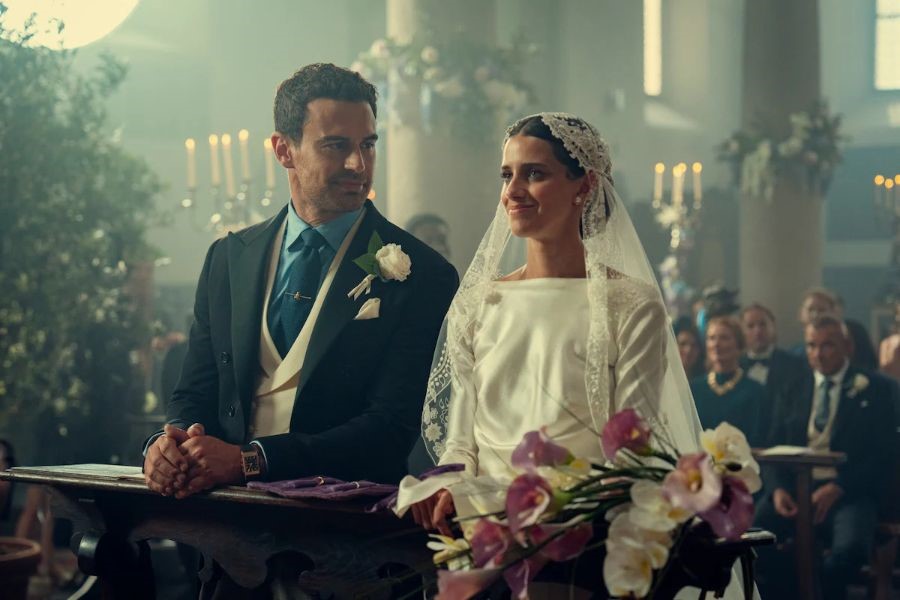
He plays Cico Maldini, the husband of Italian aristocrat Bella, played by Benedetta Porcaroli. Netflix describes Cico as a small-time Italian criminal with an extensive network of contacts who becomes Eddie and Susie’s local fixer as their business expands into Northern Italy. Sergio Castellitto, meanwhile, plays Marco Moretti, a far more powerful Italian crime boss. The new season deliberately widens the universe of the series beyond England, moving from the British countryside to the Italian lakes.
Morrone’s role may be relatively brief, but it is certainly memorable — not least because of the tiger. I will say no more for those who have not yet watched it.
At the moment, however, The Gentlemen is quite simply my favourite series.
And the reason can be summed up in one word: writing.
The scripts are beautifully constructed. The dialogue is sharp, fast and meticulously written, while the storytelling moves at such speed that the series never seems to lose momentum. Something is always happening. Yet the rhythm never feels mechanical. There is room for character, absurdity and some wonderful moments of very dark comedy, delivered with that unmistakably British sense of humour.
There is also Guy Ritchie’s familiar taste for crime, excess and pulp, with echoes of the kind of heightened violence and grotesque humour we associate with Tarantino. Netflix officially credits Ritchie as creator, writer, director and executive producer of the series alongside a creative team that includes lead writer Matthew Read and directors Eran Creevy and Nick Rowland.
Some scenes are simply unforgettable. Season 1 already gave us the utterly surreal encounter between Freddy and Gospel’s brother — and anyone who has watched it knows exactly which chicken-related scene I mean. Season 2 continues in exactly the same spirit, including the extraordinary moments involving Bobby Glass and the mysterious little figure who appears to advise him in moments of crisis.
But what really elevates the series is its characters.
They are colourful, eccentric and sometimes completely ridiculous, but they are never flat. Susie Glass, Eddie, Freddy, Jack, Geoff, Lady Sabrina and the entire Horniman-Glass universe feel extraordinarily well defined. And the performances are so assured that even the most outrageous situations somehow remain believable within the peculiar logic of the show.
Theo James, in particular, is superb as Eddie Horniman.
The evolution of Eddie is probably one of the most interesting elements of the second season. In Season 1 he was the reluctant aristocrat trying to extricate his family from the criminal organisation operating beneath their estate. In Season 2, that has changed completely. Netflix describes him as a man who has embraced both sides of his identity — aristocrat and criminal — and who now wants to expand his empire.
And James makes that transformation completely convincing.
I also love the dynamic between Eddie and Freddy, played by Daniel Ings: two brothers who could hardly be more different and yet remain inseparably connected. The wider family relationships work just as well, with all their secrets, compromises and increasingly blurred moral boundaries.
Then there are the locations.
The English country estate, surrounded by woods and an almost mythical rural landscape, is already a character in itself. But Season 2 adds another layer of visual pleasure by moving part of the action to Northern Italy and the Italian lakes. Villas overlooking Lake Maggiore, wooden speedboats, elegant receptions and old aristocratic families create an environment built around a very particular idea of wealth: not ostentatious luxury, but inherited luxury, the kind of wealth that appears to have existed forever.
Netflix itself highlights this expansion from English estates and London power centres to the shores of Northern Italy, complete with Italian boats, villas, tailoring and classic vehicles.
And this is where the series has enormous fun with stereotypes.
Italian music, organised crime, aristocracy, Catholic imagery, beautiful villas and magnificently overdressed characters are mixed together with British upper-class codes. Even Ornella Vanoni makes her musical contribution to this wonderfully exaggerated Anglo-Italian universe.
Benedetta Porcaroli is excellent as Bella, an orphaned Italian aristocrat whom Netflix describes as equally comfortable among nobility and danger. She brings the character exactly the right mixture of elegance, vulnerability and unpredictability.
Sergio Castellitto is equally effective as Marco Moretti, elegant and threatening in precisely the way a Guy Ritchie crime boss should be. And Morrone clearly enjoys playing against the romantic alpha-male image associated with so many of his previous roles: Cico is rougher, less polished and considerably less seductive.
The contrast works brilliantly.
This second season is also bigger in scope. Eddie and Susie are no longer merely protecting an inherited criminal operation; they are actively trying to expand it internationally. According to Netflix, that geographical and thematic expansion was part of the concept from the beginning, taking the story from the English countryside to the Italian lakes and introducing a much larger network of allies, aristocrats, criminals and enemies.
And yet, despite the scale, what keeps me watching — and rewatching — is not the luxury, the violence or even the increasingly insane plot twists.
It is the craft.
The writing, the dialogue, the direction, the performances, the production design, the costumes, the music and above all the rhythm work together with extraordinary precision.
So, after experimenting with all those two-minute romances, I have reached my conclusion.
For the moment, at least, no more microdramas for me.
Long live The Gentlemen, Guy Ritchie and his superb team.
Long live The Gentlemen, Guy Ritchie and his Superb Team