
The long-standing relationship between animation and video games is entering a new phase. No longer limited to adaptations, spin-offs or franchise extensions, the two industries are increasingly sharing creative systems, production tools and development methodologies.
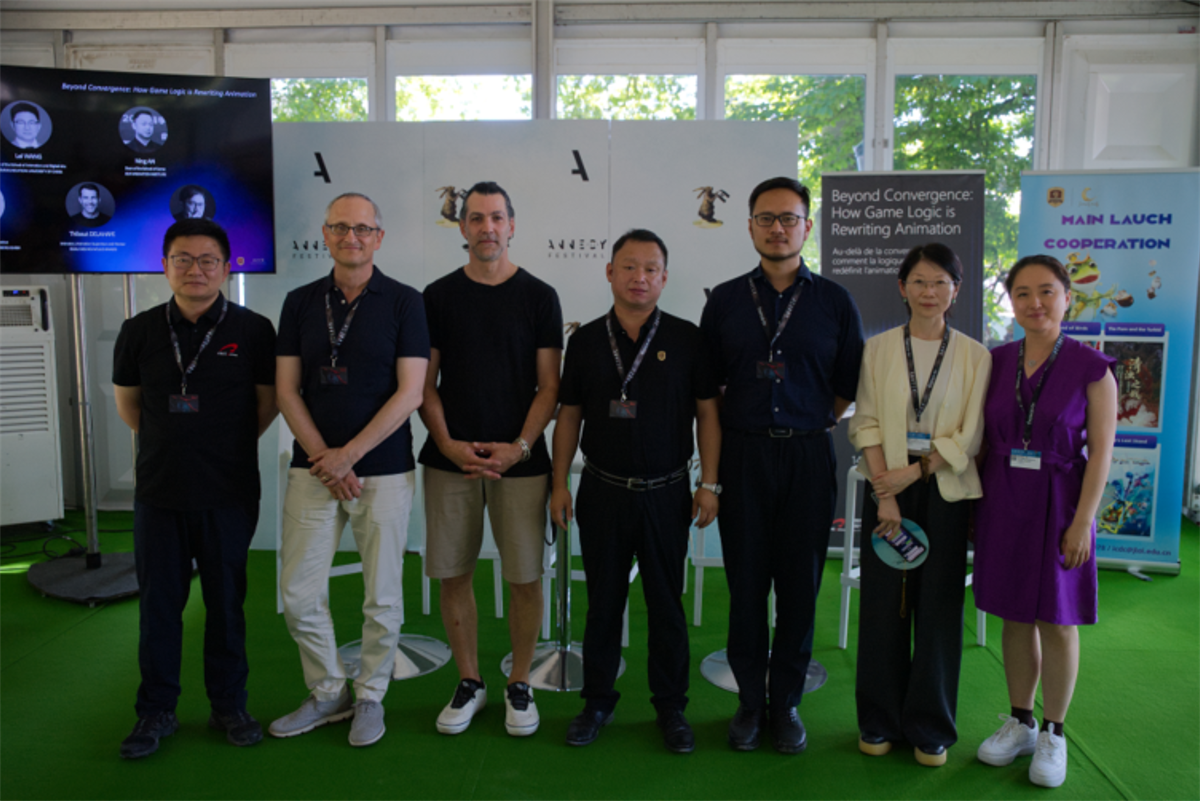
This shift was at the centre of the official MIFA panel Beyond Convergence: How Game Logic Is Rewriting Animation, held during the Annecy International Animation Film Festival. The session brought together leading voices from China and Europe to discuss how game development, real-time technologies, AI and interactive storytelling are transforming animation production, IP creation and the creative pipeline.
Organised by the School of Animation and Digital Arts at the Communication University of China (CUC), Jilin Animation Institute (JAI) and the Alliance Cinéaste Chine-Europe (ACCE), the panel examined a key question for the global creative industry: what happens when animation begins to think not only in terms of stories, but also in terms of systems?
The discussion was moderated by Wei Shen, Head of International Affairs at CUC’s School of Animation and Digital Arts, and featured Lei Wang, Dean of the School of Animation and Digital Arts at CUC; Ning An, Dean of the School of Game at JAI; Jan Pinkava, Director of the Animationsinstitut at Filmakademie Baden-Württemberg and Academy Award-winning filmmaker; and Thibaut Delahaye, animator, animation supervisor and mentor at École des Nouvelles Images, whose recent credits include the Oscar-winning feature Flow. Opening remarks were delivered by Jian Wang, Secretary-General of the China Animation Association.
The panel highlighted how the connection between animation and games has moved far beyond the traditional exchange of content. Instead of simply turning animated films into games, or games into animated series, creators are now adopting shared tools and creative processes. Real-time engines, interactive design, audience participation and systems-based storytelling are becoming increasingly central to the way new animated worlds are conceived.
According to Lei Wang, future creators will need to think beyond single-medium storytelling and develop intellectual properties capable of living across different formats and platforms. “Animation creates stories that have already happened. Games create systems that continuously generate experiences. The creators of tomorrow won’t simply tell stories — they will build worlds,” he said.
His reflection points to a broader transformation across the creative industries, where successful IP is increasingly built through long-term engagement, interaction and participation rather than through a single linear narrative. In this context, animation is not only a storytelling medium, but also a platform for world-building.
Ning An underlined that game logic should not be seen merely as a technological tool, but as a different creative mindset. As animation and games continue to converge, he argued, education must prepare students to design not only stories and characters, but also interactive systems that audiences can actively explore.
At the same time, the European speakers stressed that technological innovation should reinforce, rather than replace, the fundamentals of artistic practice. Jan Pinkava noted that storytelling, composition, character and design remain essential skills, regardless of how fast software and production pipelines evolve. “Technology will continue to change, but good composition, character, storytelling and design never go out of date,” he said.
Thibaut Delahaye also pointed to the need for flexibility in an industry where the boundaries between animation, games, television and immersive media are becoming increasingly fluid. However, he warned against confusing interdisciplinarity with a loss of expertise. “The industry needs specialists with open minds — not generalists who know a little about everything,” he said.
Although hosted by leading animation schools, the conversation extended well beyond academia. Audience members from animation studios, game companies and creative organisations across Europe, Asia and Africa joined the debate, raising questions about AI, real-time production, talent development, interactive storytelling and future models of cross-media collaboration.
The discussion reflected a growing consensus: animation and games are no longer parallel sectors. They are becoming part of a broader creative ecosystem in which technology, storytelling, audience participation and IP development are increasingly interconnected.
At Annecy, Industry Leaders Explore How Game Logic Is Rewriting Animation