
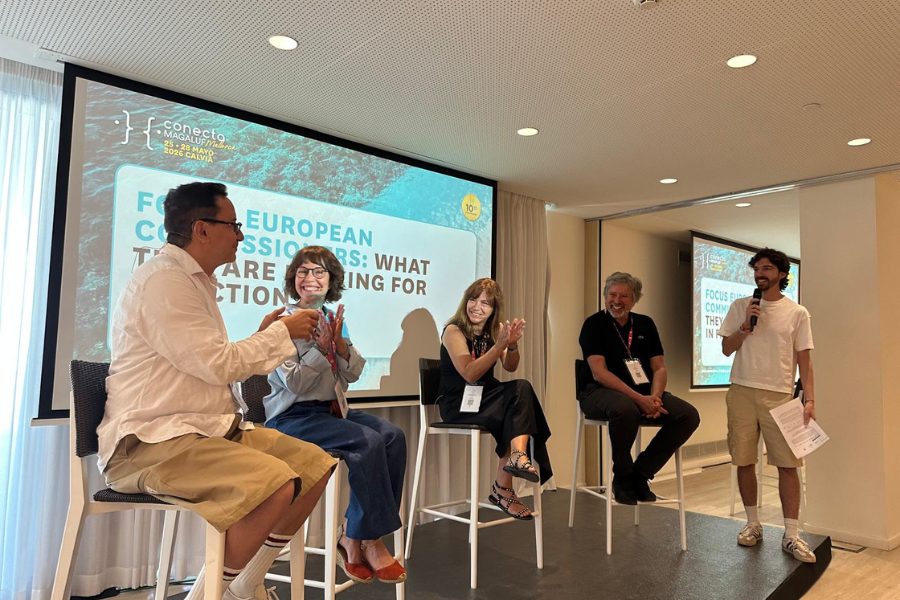
The session brought together Morad Koufane, Director of International Drama and Youth at France Télévisions; Michele Zatta, Commissioning Editor of International Co-productions at RAI; Ludovica Fonda, Head of co-production at Mediaset; and Margarida Pereira, Head of Acquisitions and Sales at TVI. They mapped out a European fiction landscape in which public-service values, commercial accessibility, local identity and international collaboration must coexist.
For Morad Koufane, France Télévisions’ international drama strategy is built around two complementary editorial pillars. The first is rooted in the broadcaster’s public-service mission: projects capable of reflecting contemporary realities and speaking to the world we live in today. He cited titles such as Kabul and In Her Car, set against the backdrop of Ukraine, as examples of stories that carry a strong civic and contemporary dimension. In this direction, he also mentioned the development of Revolution, a series set in Iran.
At the same time, France Télévisions remains open to ambitious, high-profile entertainment IPs with broad audience appeal. Koufane referred to productions such as Around the World in 80 Days, Lucky Luke and the upcoming Lancelot, underlining the broadcaster’s continued interest in large-scale, six-part series with strong brand recognition. What the group is not actively seeking, he clarified, are conventional period dramas or crime procedurals, as these genres are already efficiently covered by domestic production teams.
Koufane also highlighted the importance of the European Alliance, the partnership between France Télévisions, ZDF and RAI, which continues to generate regular calls for projects, including a recent focus on romantic comedy.
From the Italian public broadcaster’s perspective, Michele Zatta described RAI as a flexible and pragmatic partner, open to both majority and minority co-productions. However, he stressed that the success of any international collaboration depends first and foremost on creative chemistry. Co-producing, he suggested, means entering a demanding relationship in which partners must genuinely share the same vision of the story and its tone.
Zatta recalled previous international experiences, including Los Ojos del Diablo, developed with Mediaset España and Mediterráneo, and a more unusual project with Finland’s Yle, titled Lapponia I love iù. The idea emerged from a conversation with Yle’s Head of Drama, Jarmo Lampella, around a simple question: what do Italy and Finland have in common? The answer — apparently nothing — became the creative starting point for a love story set in Lapland and centred on the difficulty of communication.
For producers interested in working with RAI, Zatta was clear about one key requirement: an Italian element must be present on screen. In practical terms, this often means at least one Italian actor, because RAI’s audience remains attached to recognisable national components. He also noted that the broadcaster’s core drama audience is predominantly female and particularly loyal to returning series.
Representing the commercial side of the Italian market, Ludovica Fonda outlined Mediaset’s approach within the wider European framework of MFE – MediaForEurope, which includes operations in Italy, Spain, Germany, Austria and Portugal. "Regarding production and commissioning - said Fonda -each country works independently, but we are starting to share information about reciprocal slates and we are open to assess multi-territory projects if they make sense for each and every country".
For Morad Koufane, France Télévisions’ international drama strategy is built around two complementary editorial pillars. The first is rooted in the broadcaster’s public-service mission: projects capable of reflecting contemporary realities and speaking to the world we live in today. He cited titles such as Kabul and In Her Car, set against the backdrop of Ukraine, as examples of stories that carry a strong civic and contemporary dimension. In this direction, he also mentioned the development of Revolution, a series set in Iran.
At the same time, France Télévisions remains open to ambitious, high-profile entertainment IPs with broad audience appeal. Koufane referred to productions such as Around the World in 80 Days, Lucky Luke and the upcoming Lancelot, underlining the broadcaster’s continued interest in large-scale, six-part series with strong brand recognition. What the group is not actively seeking, he clarified, are conventional period dramas or crime procedurals, as these genres are already efficiently covered by domestic production teams.
Koufane also highlighted the importance of the European Alliance, the partnership between France Télévisions, ZDF and RAI, which continues to generate regular calls for projects, including a recent focus on romantic comedy.
From the Italian public broadcaster’s perspective, Michele Zatta described RAI as a flexible and pragmatic partner, open to both majority and minority co-productions. However, he stressed that the success of any international collaboration depends first and foremost on creative chemistry. Co-producing, he suggested, means entering a demanding relationship in which partners must genuinely share the same vision of the story and its tone.
Zatta recalled previous international experiences, including Los Ojos del Diablo, developed with Mediaset España and Mediterráneo, and a more unusual project with Finland’s Yle, titled Lapponia I love iù. The idea emerged from a conversation with Yle’s Head of Drama, Jarmo Lampella, around a simple question: what do Italy and Finland have in common? The answer — apparently nothing — became the creative starting point for a love story set in Lapland and centred on the difficulty of communication.
For producers interested in working with RAI, Zatta was clear about one key requirement: an Italian element must be present on screen. In practical terms, this often means at least one Italian actor, because RAI’s audience remains attached to recognisable national components. He also noted that the broadcaster’s core drama audience is predominantly female and particularly loyal to returning series.
Representing the commercial side of the Italian market, Ludovica Fonda outlined Mediaset’s approach within the wider European framework of MFE – MediaForEurope, which includes operations in Italy, Spain, Germany, Austria and Portugal. "Regarding production and commissioning - said Fonda -each country works independently, but we are starting to share information about reciprocal slates and we are open to assess multi-territory projects if they make sense for each and every country".
Unlike a public broadcaster, Mediaset’s priority is to serve a broad, mainstream linear audience on Canale 5. Its international drama division works closely with the local drama team to develop content with an “international DNA”, while remaining fully aligned with the needs of a mass-market commercial schedule.
Fonda explained that Mediaset looks for stories that are accessible, emotionally engaging and easy to follow, especially because viewers must be retained across advertising breaks. The target is a broad family audience, roughly aged 15 to 64. In terms of genre, Mediaset is particularly interested in family dramedies, procedurals with a fresh twist and what Fonda defined as “thriller melo” — a mix of passion, mystery, suspense and investigation, often set against sensitive social issues.
As an example, she mentioned A Testa Alta (in coproduction with Banijay Italia), a drama centred on a female high-school principal whose life is disrupted when an intimate video goes viral. Rather than being defeated, the protagonist chooses to react with dignity and determination, turning the story into an aspirational journey with an investigative element.
This aspirational dimension is essential for Mediaset. Fonda emphasised that, for such a mainstream screen, stories should not alienate or frighten the audience. Even when dealing with difficult themes, they need emotional resolution, clarity and often a positive ending. She also pointed to the enduring appetite for family comedy, citing I Cesaroni, the successful Italian adaptation of the Spanish format Los Serrano, as evidence that younger generations are still attracted to this kind of warm, relatable storytelling.
Also, Fonda added: "As co-productions are concerned, we are co-producing with Sequoia Studios in Spain, El Laberinto de las Mariposas, The Labyrinth of Butterflies, that is an action-romantic thriller starring the turkish actor Can Yaman, that is a super important talent for our channel, and this co-production is a great opportunity to explore new narratives, territories."
Finally, Margarida Pereira offered an insight into the Portuguese market, where television fiction has long been shaped by the central role of the telenovela. Portugal may not always be grouped with Europe’s largest drama territories, but Pereira reminded the audience that the country is one of the continent’s most prolific producers of long-running drama, with around 1,500 hours produced annually by the two main commercial broadcasters.
These daily long-form productions are difficult to co-produce internationally because of their volume, rhythm and specific local audience habits. However, TVI also produces four to five shorter series each year, and it is within this space that international collaborations become more feasible.
Pereira acknowledged that even co-producing with neighbouring Spain can be complex. Despite geographic proximity, Portugal and Spain have different languages, cultural references and narrative expectations. Stories that work naturally for both countries often need to be built around border areas or shared situations that do not feel forced. Nevertheless, TVI remains open to cross-border projects, both for its daily drama slots and for shorter fiction formats.
The panel ultimately confirmed that European commissioners are not looking for generic international fiction. They are looking for projects with a precise editorial identity, a clear audience target and a credible reason to travel. For public broadcasters, this may mean stories that combine contemporary relevance with cultural responsibility. For commercial broadcasters, it means emotional accessibility, recognisable characters and broad appeal. Across all territories, however, one principle remains constant: international co-production only works when the creative partnership is rooted in genuine alignment, not just financial necessity.
Finally, Margarida Pereira offered an insight into the Portuguese market, where television fiction has long been shaped by the central role of the telenovela. Portugal may not always be grouped with Europe’s largest drama territories, but Pereira reminded the audience that the country is one of the continent’s most prolific producers of long-running drama, with around 1,500 hours produced annually by the two main commercial broadcasters.
These daily long-form productions are difficult to co-produce internationally because of their volume, rhythm and specific local audience habits. However, TVI also produces four to five shorter series each year, and it is within this space that international collaborations become more feasible.
Pereira acknowledged that even co-producing with neighbouring Spain can be complex. Despite geographic proximity, Portugal and Spain have different languages, cultural references and narrative expectations. Stories that work naturally for both countries often need to be built around border areas or shared situations that do not feel forced. Nevertheless, TVI remains open to cross-border projects, both for its daily drama slots and for shorter fiction formats.
The panel ultimately confirmed that European commissioners are not looking for generic international fiction. They are looking for projects with a precise editorial identity, a clear audience target and a credible reason to travel. For public broadcasters, this may mean stories that combine contemporary relevance with cultural responsibility. For commercial broadcasters, it means emotional accessibility, recognisable characters and broad appeal. Across all territories, however, one principle remains constant: international co-production only works when the creative partnership is rooted in genuine alignment, not just financial necessity.