
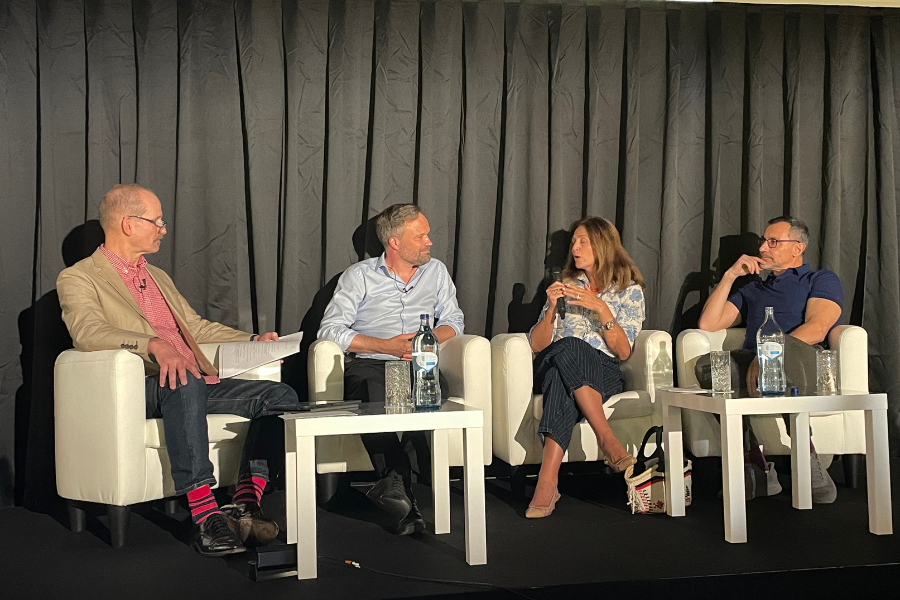
What emerged was not a single commissioning model, but three distinct strategies—each shaped by local market dynamics, audience expectations and structural constraints. Yet, beneath these differences, a shared tension is clearly visible: how to balance innovation with risk, and relevance with scale.
Between Public Mission and Digital Pressure: NRK
For NRK, the challenge is not only to compete with global platforms, but to remain meaningful in a rapidly evolving media landscape. As Jostein Olseng outlined, the public broadcaster’s role is still rooted in its ability to create shared experiences—programmes that resonate across generations and reinforce a sense of cultural cohesion.
Rather than focusing exclusively on younger demos, NRK is prioritising content that can bring audiences together, often across age groups. In this sense, the most successful titles are not necessarily youth-oriented, but multi-layered shows that different generations can engage with simultaneously. At the same time, the broadcaster is fully embracing a digital-first approach. This does not simply mean shifting distribution, but rethinking commissioning itself: projects must be strong enough to justify active audience choice.
In an environment where content is abundant, relevance becomes the key currency. For NRK, this translates into stories that carry meaning—whether by offering new perspectives, emotional depth or social insight.Despite mounting financial pressure, the strategy is not to retreat into safer, lower-cost genres. On the contrary, the broadcaster is navigating a careful balance between reinforcing established brands and continuing to take creative risks. The objective is clear: standing out is no longer optional—it is a necessity.The Weight of the Schedule: SIC
If NRK operates within a public service logic, SIC’s commissioning strategy is deeply shaped by the structure of its schedule and the realities of a smaller market.
As Vanessa Tierno explained, the Portuguese broadcaster remains strongly anchored in a linear, generalist model, where the grid dictates the type of content that can be commissioned.
Weekday primetime is largely dominated by telenovelas and daily formats, leaving limited space for new entertainment concepts. As a result, most opportunities are concentrated in weekend slots, where competition is high and risk tolerance is low.
In this context, clarity becomes essential.
A successful pitch must be immediately understandable—not only for commissioners, but for the audience. The concept needs to communicate its value instantly, without ambiguity. At the same time, it must deliver a strong visual or editorial hook capable of standing out in an increasingly crowded market.
However, the decisive factor remains economic sustainability. Budget constraints are significantly impacting commissioning decisions, pushing broadcasters toward formats that can be efficiently produced, adapted across different slots and extended over multiple seasons.
In Portugal, where the audience skews older, the core target remains the family viewer. Younger audiences are still relevant, but are often reached through secondary touchpoints such as social media and on-demand platforms.
This has led SIC to adopt a pragmatic approach: investing in fewer, stronger brands, maximising their lifecycle and building them into multi-platform experiences.
Originality is still valued—but only when it aligns with scheduling needs and financial logic. In many cases, innovation takes the form of reinterpreting proven genres, rather than introducing entirely new ones.
The Power of Event Television: Mediaset
In Italy, Mediaset is taking a different direction—one that reinforces the unique strengths of traditional broadcasting. As Fabrizio Battocchio highlighted, the group’s strategy is centred on creating television events: large-scale programmes capable of gathering mass audiences in real time. In a market where linear TV still reaches an overwhelming majority of the population, (95% of the Italian population), the focus is not on competing with streaming platforms on their terms, but on offering something they struggle to replicate: collective viewing experiences.
This means investing in formats with strong emotional impact, high production value and a clear sense of occasion. Shows are designed to be watched live, often incorporating interactive elements such as voting and studio participation.
At the same time, Mediaset is aware of the need to evolve its content language—particularly in the reality space, where long-running formats risk becoming predictable. The challenge is to innovate without losing the broad appeal that defines mainstream entertainment.
Interestingly, this does not necessarily mean reducing scale. On the contrary, the strategy involves concentrating resources on fewer, bigger projects, particularly on flagship channels and key primetime slots.
The objective is not simply to retain audiences, but to reaffirm television’s role as a shared cultural experience.
Three Strategies, One Industry Shift
Although NRK, SIC and Mediaset operate within very different frameworks, their approaches reveal a common underlying shift.
The era of abundant commissioning and rapid experimentation has given way to a more selective environment, where every project must justify its existence—editorially, strategically and economically.
For producers, this means that success depends less on the originality of an idea alone, and more on its alignment with the broadcaster’s identity.
A concept that works for NRK—driven by meaning and relevance—may not fit SIC’s schedule-driven model, or Mediaset’s event-based strategy.