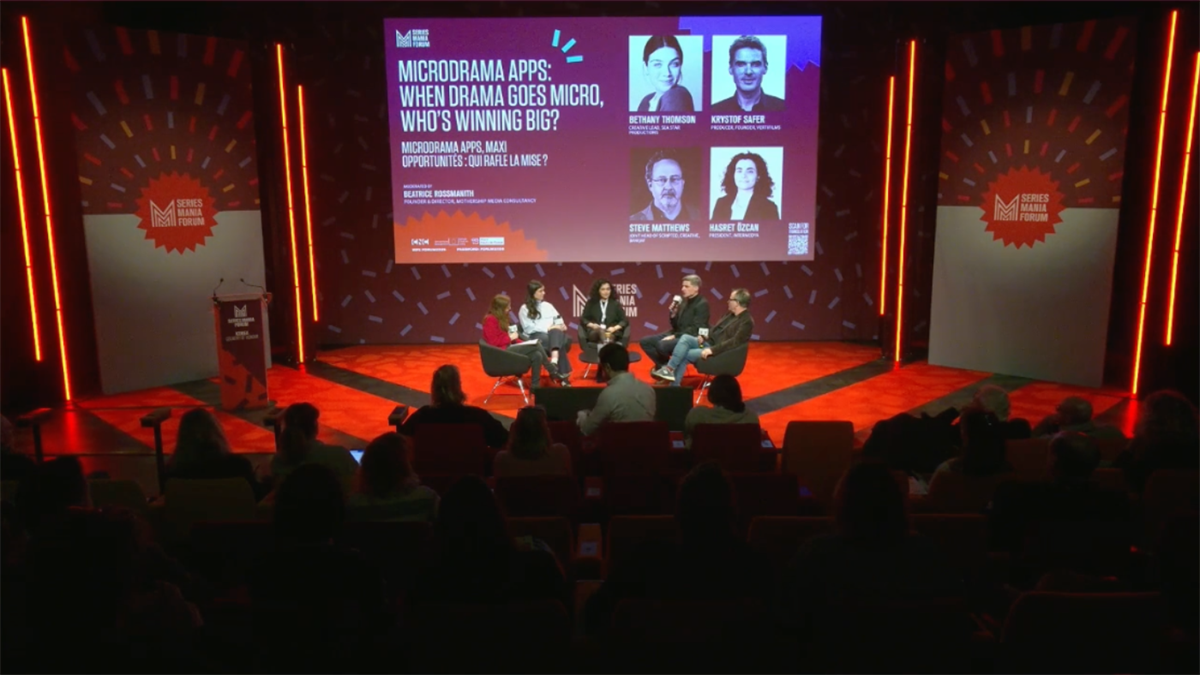

At a time when the global television industry is still recalibrating after the so-called peak TV era, vertical drama is rapidly emerging not just as a new format, but as a fundamentally different production and storytelling ecosystem. This was the central focus of the panel “Vertical Drama: What Are We Talking About? – Innovation & Digital-first Storytelling”, presented by Beatrice Rossmanith, Founder & Director of Mothership Media Consultancy, which brought together key industry voices to unpack the phenomenon from both a strategic and creative perspective.
Rossmanith opened the session with a data-driven overview of the vertical drama landscape, framing it as a system rather than a genre. Microdramas—typically structured in ultra-short episodes and designed for mobile-first consumption—are experiencing explosive global growth, with time spent on short drama apps increasing by over 300 percent since 2024. The model is driven by scale, speed and iteration: low production costs, compressed timelines and continuous output replace the traditional commissioning logic of high-risk, high-budget productions. In markets like China, where tens of thousands of series are produced annually, the process resembles content manufacturing more than conventional storytelling, increasingly powered by AI tools that analyse user behaviour, optimise narrative hooks and even influence script development .
This industrial logic is closely tied to monetisation. Unlike traditional television or streaming, where revenue is layered onto content, vertical drama integrates monetisation directly into the narrative structure, with cliffhangers strategically positioned around paywalls. The audience—predominantly female and highly engaged—is not only consuming but actively shaping the content through data feedback loops, making this one of the most responsive storytelling ecosystems currently in operation .
Against this backdrop, the panel discussion shifted towards the creative implications of this model. Bethany Thomson (Sea Star Productions), Krystof Safer (Vertifilms), Hasret Ozcan (Inter Medya) and Steve Matthews (Banijay Entertainment UK) explored the tension between data-driven production and narrative ambition, questioning whether vertical drama is simply a reduced version of traditional storytelling or an entirely new language.
One of the key points raised was that vertical drama cannot be treated as “cut-down television”. Attempting to adapt existing IP by simply reformatting it into vertical does not work, as audiences consuming content in this format are fundamentally different. Instead, the challenge lies in rethinking storytelling from the ground up, starting with pacing, emotional immediacy and accessibility. As Thomson noted, there is an opportunity to tap into underserved audiences—particularly those seeking escapism but lacking the time commitment required by long-form series—by drawing inspiration from adjacent ecosystems such as BookTok and romantic fantasy publishing.
At the same time, the discussion highlighted how strongly the current market is skewed towards female audiences, with romance-driven narratives dominating due to their proven monetisation potential. Ozcan pointed out that this aligns with broader media consumption patterns, where women—particularly over 25—represent the most consistent paying audience. However, several panellists suggested that the format could expand into other genres such as horror, sci-fi and thriller, particularly in markets where those genres already perform strongly, although monetisation models for these segments remain less defined.
Krystof Safer offered a more provocative perspective, arguing that microdrama should not be confined to a single genre classification at all. Instead, it represents a behavioural shift: audiences discovering narrative content within the same environment as social media, and choosing to immerse themselves in a continuous, mobile-native storytelling experience. In this sense, vertical drama competes less with traditional television and more with the broader attention economy of platforms like Instagram and TikTok.
Another recurring theme was repetition and standardisation. The current ecosystem is heavily influenced by algorithmic production, with platforms often replicating successful narrative templates rather than investing in originality. While this raises concerns about creative fatigue, panellists noted that repetition has always been a feature of popular storytelling, from soap operas to genre cinema. The real challenge lies in balancing familiarity with innovation, particularly within the constraints of extremely short episode durations.
These constraints, however, are also seen as a creative opportunity. Writing for microdrama requires a radical compression of narrative structure: characters must be established instantly, often through visual cues such as costume and archetypal traits, while each episode must deliver immediate emotional impact and a compelling hook. As Matthews observed, this demands a different kind of writer—one who sees limitation not as a restriction, but as a framework for experimentation.
Ultimately, the panel converged on the idea that vertical drama is not simply a passing trend, but an evolving form that reflects deeper shifts in audience behaviour, attention spans and content economics. While Europe may not compete with Asia or the US in terms of volume, it could carve out a distinctive position through more authored, culturally specific and premium approaches to vertical storytelling.
Microdrama Is Not a Passing Trend but a Structural Shift in Global Storytelling