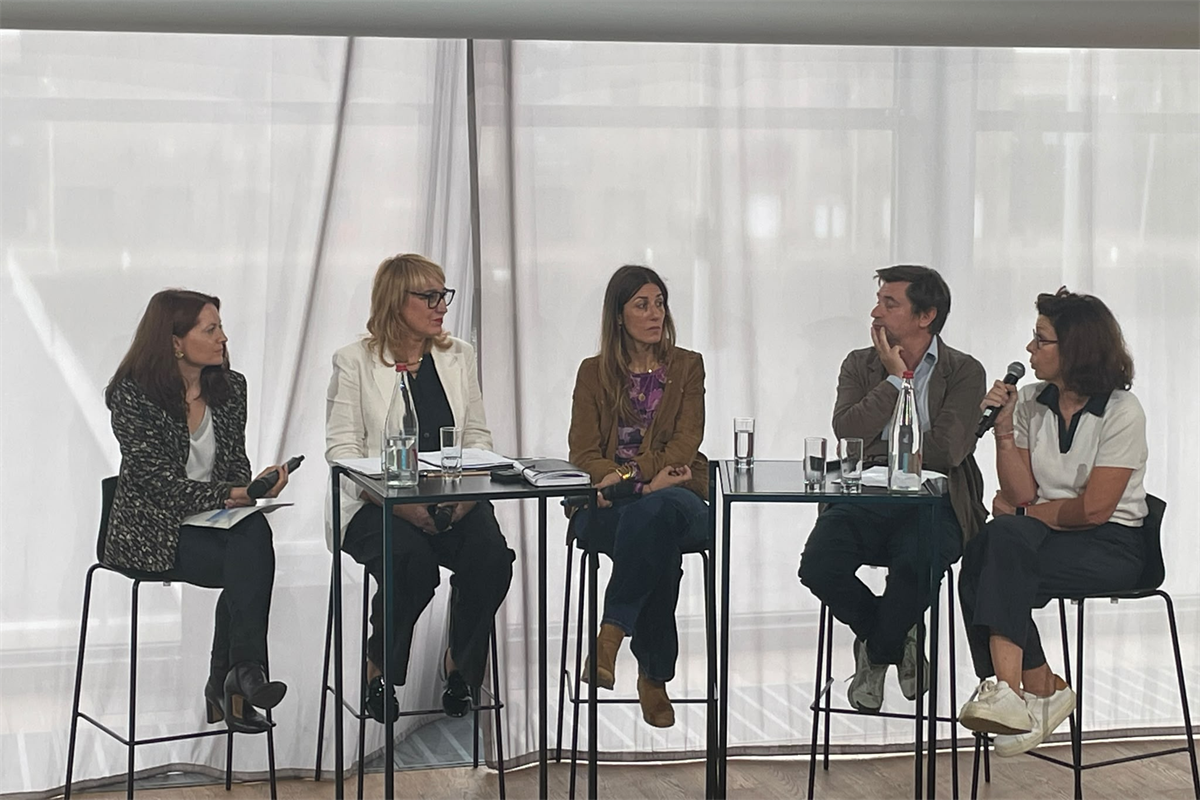
The presentation of the 2025 figures was followed by a panel entitled “The Evolving Audiovisual Market: How to Adapt?”, moderated by CNC's Cécile Lacoue and Unifrance's Sarah Hemar.
The discussion brought together three executives who also hold prominent positions within France's audiovisual distribution community: Julie Tolza, Director of Documentaries at Seventine and President of Unifrance's Audiovisual Distributors Commission; Ulrich Lagriffoul, SVP Distribution Europe & MENA at Mediawan Rights and Vice-President of the Commission; and Morgann Favennec, Deputy CEO of Mediatoon Distribution and a member of Unifrance's executive committee.
Their discussion suggested that the downturn goes considerably deeper than a simple year-on-year fall in export revenues.
One of the clearest structural changes is the growing fragmentation of international sales. Large multi-territory and regional deals have become less common, increasingly requiring distributors to negotiate individual territories and individual exploitation windows separately. This makes international distribution more complex and resource-intensive while reducing the visibility distributors once had over future revenues.
At the same time, buyers are becoming more selective and committing later. For distributors involved in pre-financing, particularly in documentary and animation, this creates an additional problem: international sales can no longer be relied upon at the same stage of a project's financing plan as they once were.
Tolza highlighted the particular difficulties facing documentary distribution, where both the number of transactions and, in some cases, rights values are under pressure. Later commitments from broadcasters also make it harder for distributors to participate in financing projects upstream.
Favennec pointed to animation as another sector where the correction has become especially visible. France has historically been one of the world's strongest animation exporters, but the genre fell to third place in French audiovisual export sales in 2025 after a 30.3% decline. The contraction follows several years of pressure on the sector as global platforms reduced commissioning and broadcasters tightened children's content budgets.
Lagriffoul offered a different reading of the figures, suggesting that international value has not disappeared altogether but is becoming concentrated around a smaller group of programmes. Buyers are still prepared to pay for distinctive or demonstrably commercial titles, but a broader middle tier of content is finding it increasingly difficult to secure meaningful international revenues.
The decline in production volumes could reinforce that trend. Fewer commissions today mean fewer new titles reaching distributors in the coming seasons, potentially creating an international market with a smaller pipeline and stronger competition around the programmes considered most valuable.
For French distributors, adapting therefore means more than simply finding new buyers. It involves closer producer-distributor collaboration, earlier strategic positioning of projects, diversification of financing sources and stronger relationships with individual territories.
The panel also underlined the continuing importance of European partnerships. Belgium and Switzerland remain significant financing and acquisition partners, particularly for documentaries, while distributors are increasingly looking for combinations of territorial pre-sales, co-production and new digital exploitation models to replace the larger deals that previously supported international financing.
The paradox emerging from Le Havre is therefore clear: French programmes continue to circulate widely around the world, but turning that visibility into sustainable revenues has become considerably more complicated.
How French Distributors Are Adapting to a More Fragmented Global Market