The third day of NEM Dubrovnik 2026 brought together a wide range of industry executives to examine how accelerating audience fragmentation, shifting platform economics and ongoing corporate consolidation are reshaping the global media landscape. Across panels, discussions moved from the rise of microdramas and FAST channels to the strategic pressure created by mergers and acquisitions, reinforcing a central theme: the industry is being reorganised around scale, distribution and new narrative formats.
Microdramas and Emerging Content Models
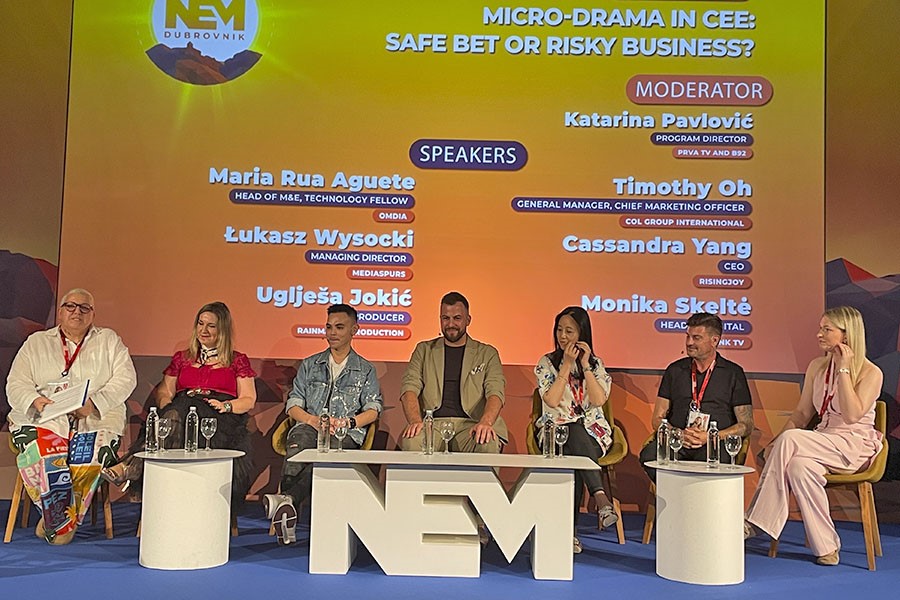
The microdrama discussion emerged as one of the most dynamic sessions of the day, focusing on whether the format represents a structural opportunity or a high-risk experiment for Central and Eastern Europe and beyond. Maria Rua Aguete (Omdia) positioned microdramas as a fast-growing global category driven by mobile-first consumption and fragmented attention spans. She highlighted that audiences are increasingly comfortable with short, serialized vertical storytelling and are already showing willingness to pay for impulse-driven content consumption. Rather than a niche trend, she framed microdramas as a measurable and monetisable segment of the broader content economy. Timothy Oh (COL Group International) argued that microdramas should not be seen as disruption but as convergence. According to him, audiences are not changing habits, but migrating existing behaviours from social platforms into structured storytelling environments. However, he stressed that success depends on native vertical production logic, not adaptation of traditional formats. Several speakers underlined that execution and localisation are decisive. Uglješa Jokić (Rainmaker Production) stressed that the format only works when developed locally, with strong cultural adaptation and monetisation frameworks. Monika Skeltė (LNK TV) added that the real risk is not the format itself, but ignoring the already established shift toward mobile-first consumption. A broader consensus emerged that microdramas are no longer experimental. Instead, they are becoming a structural layer in the content ecosystem, requiring tailored production, distribution and monetisation strategies rather than isolated testing.
Platform Strategy and Distribution Shifts
A separate strand of discussion focused on platform strategy and the growing importance of distribution ecosystems, with YouTube increasingly positioned as a primary rather than secondary distribution layer. Speakers emphasised that broadcasters and producers are now operating in hybrid environments where content must be optimised across multiple platforms with different economic models. This has shifted distribution from a marketing function to a core strategic pillar. Guy Bisson (Ampere Analysis) highlighted the scale of audience migration toward digital platforms, noting that a significant share of households now rely primarily on streaming ecosystems rather than traditional broadcast services. This trend, he argued, is fundamentally changing how content is discovered, monetised and retained. Milena Djuričić (Videomite) stressed that digital distribution can no longer be treated as optional. She argued that success depends on volume, consistency and platform-native design, while also highlighting the untapped value of existing catalogues if properly activated for global distribution.
Aleksandar “Kojot” Ašković and Karina Rompa (Media Hansa) reinforced the importance of ecosystem thinking. They noted that successful channels require sustained output, strategic packaging and a deep understanding of recommendation systems, rather than isolated publishing decisions. Across the panel, a clear conclusion emerged: visibility alone is no longer enough. Sustainable performance depends on aligning content structure with platform logic.
Mergers and Acquisitions: Scale Vs. Fragmentation
The closing discussions returned to mergers and acquisitions, highlighting how consolidation continues to reshape global media structures. Speakers noted that potential mega-mergers could significantly alter competitive dynamics by consolidating subscriber bases, expanding distribution reach and strengthening bargaining power against global tech platforms. At the same time, concerns were raised about the long-term impact on media pluralism. While consolidation offers efficiency and scale, it also reduces the number of commissioning entities and may limit opportunities for independent producers. This tension between economic necessity and cultural diversity was a recurring theme throughout the discussion. Ultimately, consolidation was framed as a structural response to market pressure rather than a strategic choice, with its impact depending on how effectively companies balance global scale with local relevance.
Consolidation, Microdramas and Platform Strategy Reshape Industry Debate at NEM Dubrovnik