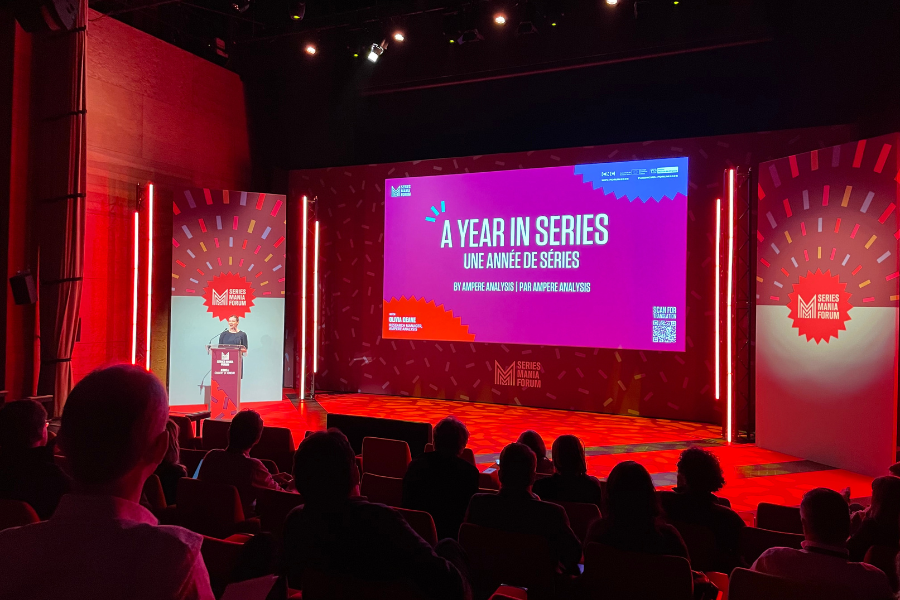

At Series Mania on Tuesday, March 24, a forward-looking and data-rich session led by Olivia Deana from Ampere Analysis titled " A Year of Series", provided a much-needed framework to understand the current transformation of the television industry. Framed around three key pillars—revenue generation, the long-term impact of streaming disruption, and emerging future trends—the session offered a clear conclusion: the industry has entered what Deana defined as the “post-peak TV era.”
From Peak TV to Stability
Rather than portraying the current phase as a crisis, Deana reframed the narrative. While the years between 2020 and 2022 represented an exceptional boom—driven by aggressive streaming investment—the period from 2023 to 2025 should be understood as a phase of stabilization.
Revenue growth in Western Europe has slowed significantly, dropping from a $15.2 billion increase during the peak years to $9.3 billion in the following period. This deceleration is largely due to market saturation, with subscription penetration reaching 139% by 2025.
However, the key insight is that the slowdown is not as catastrophic as it may appear. While revenue growth declined by more than 50%, spending on original content decreased by only 3%, indicating that the industry remains structurally resilient.
The Shift in Streaming Economics
One of the most important structural changes highlighted in the session is the evolution of streaming business models. Faced with saturation, platforms have increasingly turned to ad-supported tiers, which accounted for 73% of revenue growth among major players in the post-peak era.
This shift has allowed streamers to:
Diversify revenue streams beyond subscriptions
Target lower-income audiences previously excluded from premium SVOD models
However, Deana cautioned that this strategy has limits. As saturation extends across all demographic segments, the long-term sustainability of ad-driven growth remains uncertain.
The Rise of the Acquisition-First Strategy
A direct consequence of these economic adjustments is a strategic pivot in commissioning. Five out of six major global streamers—including Netflix, Amazon, Disney, and Paramount—have reduced their commissioning activity in Western Europe, while simultaneously increasing their reliance on acquired content.
This marks the emergence of an “acquisition-first market”, where finished content becomes increasingly valuable. The implication for producers is clear: opportunities lie not only in development but in delivering ready-to-distribute, exportable titles.
An exception to this trend is HBO, which continues to invest in original productions as part of its ongoing market expansion strategy.
Pressure on Production and Changing Genre Dynamics
Despite relatively stable spending levels, commissioning has been impacted by production bottlenecks and cost pressures. In response, commissioners are prioritizing formats that are faster and more efficient to produce.
This has led to:
A decline in high-cost, long-production genres such as sci-fi, fantasy, and high-end drama
A rise in shorter formats, including limited series and mini-series
Increased investment in genres with shorter production cycles and stronger ROI potential, such as crime and thriller
The data also reveals a significant shift in renewal strategies. While renewals still account for around half of commissions, second-season renewals have dropped sharply, indicating that new titles face greater difficulty in securing long-term continuity.
A Global Supply Shift
The contraction in Western production has created a supply gap in the global market, opening opportunities for other regions. Notably, Asia-Pacific has emerged as a key growth area, with a 17% increase in scripted content premieres.
This shift is already influencing global content trends, particularly with the rise of genres such as romance and fantasy driven by Korean and anime-based storytelling.
The Next Frontier: Hybrid Media and Micro-Drama
Looking ahead, Deana identified the “small screen” ecosystem—particularly social platforms—as the next battleground for content.
While traditional television has attempted to integrate social media talent, these efforts often fall short of fully leveraging platform-native storytelling. Instead, the real opportunity lies in micro-drama formats: short-form, vertically oriented content designed for mobile consumption.
Rapid growth in micro-drama consumption, particularly in markets like Brazil and Turkey
Strong thematic focus on romance, revenge, and high-emotion narratives
A significant gap between audience demand and professional-grade supply
At the same time, traditional audience preferences remain stable. Crime and thriller continue to dominate as favorite genres, creating a strategic opportunity to align popular demand with efficient production models.
New Markets Are Emerging: Asia Leads the Shift in the Post-Peak TV Era