

Rather than signalling contraction, the numbers point to a rebalancing phase following the peak years of streaming acceleration.
The most striking signal in H2 2025 is the renewed acceleration of the United States, which strengthens its position as the world’s leading fiction producer. US releases jump from 219 in 2024 to 378 in 2025, marking a +73% year-on-year increase. This growth reinforces the country’s role not only as the largest domestic market, but also as the primary supplier of scalable, internationally exploitable IP.
Asia, while still structurally central to global fiction, shows signs of reduced intensity. Japan records a contraction, while South Korea’s growth moderates after several years of sustained expansion. This slowdown does not undermine Asia’s relevance, but suggests a shift towards more selective production strategies, particularly in genres with strong local resonance.
Europe, meanwhile, presents a picture of relative stability. The UK, France, Spain and Germany register moderate fluctuations, confirming the maturity of the region’s production ecosystem. Within this stable framework, markets such as Germany, France and Brazil stand out for their positive momentum, offsetting contractions elsewhere.
In terms of distribution, global streaming platforms continue to dominate release volumes. Netflix leads by a wide margin with 99 fiction premieres in the period, followed by Prime Video (35), Disney+ (33) and HBO Max (21). YouTube, with 10 fiction releases, further confirms the growing permeability between traditional commissioning models and platform-driven content ecosystems.
Streaming platforms concentrate nearly 60% of their output on drama and dramedy, prioritising serialisation, binge-watching potential and international circulation. Linear broadcasters remain even more focused, with over 65% of their releases in drama, reinforcing the genre’s function as a scheduling anchor for broad and recurring audiences.
This divergence reflects two distinct economic models: retention and library value for platforms versus continuity and flow for traditional channels.
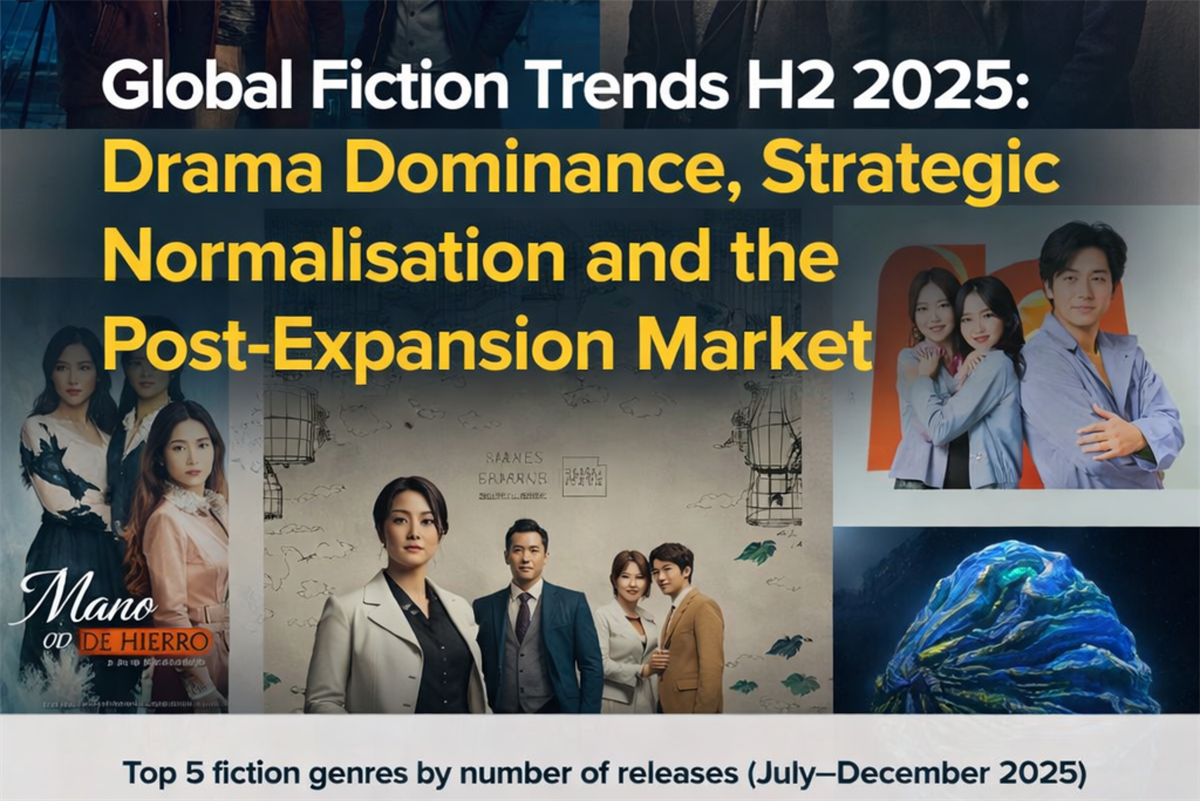
Drama series remain the undisputed backbone of the global fiction market. With 564 new titles, drama accounts for almost 60% of all releases in H2 2025. Thriller (19.1%) and love/romance (18.4%) dominate the subgenre landscape, confirming the effectiveness of emotionally driven storytelling combined with high-tension narrative structures.
At the same time, 2025 marks a decline in drama output compared to the previous two seasons, suggesting early signs of saturation after years of rapid growth. Production remains concentrated in the United States, Europe and Asia, but commissioning appears increasingly selective, with a stronger emphasis on differentiation, brand coherence and international viability.
Comedy series (159 releases) are largely built around love, relationships and family, and remain heavily concentrated in non-English-speaking markets. Russia, South Korea and Japan lead production volumes, confirming comedy as a genre deeply rooted in local cultural codes and particularly adaptable to national audiences.
Dramedy (87 releases) shows a more internationalised profile. South Korea emerges as a central hub, with strong circulation across Europe and the Americas. The genre’s hybrid nature — balancing emotion, realism and humour — continues to favour cross-cultural adaptation.
Both genres peak in 2024 and decline in 2025, pointing to a post-expansion adjustment rather than a structural slowdown.
Animation further consolidates its position as a mainstream fiction genre, not limited to children’s programming. Action/adventure dominates with 39% of releases, followed by fantasy and science fiction (11.8%), signalling strong cross-generational appeal.
Production remains highly concentrated: the United States leads with 25 titles, followed by Japan (11) and France (10). Although total output falls from 162 titles in 2024 to 123 in 2025 (-24%), levels remain above those recorded in 2021, indicating a phase of normalisation rather than market fatigue.
One of the clearest structural trends in H2 2025 concerns the origin of creative ideas.
Literary adaptations, after peaking in 2024, decline in 2025, suggesting a correction following recent overexploitation. Nevertheless, they remain the primary source of new fiction ideas. Spin-offs and sequels stabilise after a 2022 peak, while film-to-series adaptations continue to play a marginal role.
Original stories inspired by current affairs maintain a stable presence, valued for their editorial relevance and narrative legitimacy. Overall, the market appears to be recalibrating its relationship with IP, shifting from aggressive exploitation towards more curated development strategies.
The second half of 2025 confirms the ongoing vitality of international adaptations. First local versions span Europe, the Middle East, Asia and the Americas, with Turkey, South Korea and Spain remaining particularly active hubs in the remake ecosystem.
At the same time, microdramas emerge as a fast-growing segment, largely driven by US-origin IP adapted across Latin American markets. Their short-form structure, high-concept melodrama and mobile-first consumption model make them especially attractive for digital platforms.
Dramedy (87 releases) shows a more internationalised profile. South Korea emerges as a central hub, with strong circulation across Europe and the Americas. The genre’s hybrid nature — balancing emotion, realism and humour — continues to favour cross-cultural adaptation.
Both genres peak in 2024 and decline in 2025, pointing to a post-expansion adjustment rather than a structural slowdown.
Animation further consolidates its position as a mainstream fiction genre, not limited to children’s programming. Action/adventure dominates with 39% of releases, followed by fantasy and science fiction (11.8%), signalling strong cross-generational appeal.
Production remains highly concentrated: the United States leads with 25 titles, followed by Japan (11) and France (10). Although total output falls from 162 titles in 2024 to 123 in 2025 (-24%), levels remain above those recorded in 2021, indicating a phase of normalisation rather than market fatigue.
One of the clearest structural trends in H2 2025 concerns the origin of creative ideas.
Literary adaptations, after peaking in 2024, decline in 2025, suggesting a correction following recent overexploitation. Nevertheless, they remain the primary source of new fiction ideas. Spin-offs and sequels stabilise after a 2022 peak, while film-to-series adaptations continue to play a marginal role.
Original stories inspired by current affairs maintain a stable presence, valued for their editorial relevance and narrative legitimacy. Overall, the market appears to be recalibrating its relationship with IP, shifting from aggressive exploitation towards more curated development strategies.
The second half of 2025 confirms the ongoing vitality of international adaptations. First local versions span Europe, the Middle East, Asia and the Americas, with Turkey, South Korea and Spain remaining particularly active hubs in the remake ecosystem.
At the same time, microdramas emerge as a fast-growing segment, largely driven by US-origin IP adapted across Latin American markets. Their short-form structure, high-concept melodrama and mobile-first consumption model make them especially attractive for digital platforms.