
International coproduction is becoming less about formal structures and more about strategic alliances, with Spain emerging as the main bridge between Europe and Latin America, according to new data presented by GECA at Iberseries & Platino Industria 2026.
During the session Coproducciones: tendiendo puentes entre Iberoamérica y Europa, held at Iberseries 2026, Gloria Saló, Director of Production and Content Consulting at GECA, and Lucía Gómez, Content and Formats Analyst at GECA, examined how international fiction partnerships are evolving and which territories are currently driving them.
One of the key messages of the presentation was that coproduction should no longer be viewed simply as a financing solution, but as a broader development and exploitation strategy, bringing together complementary strengths across territories. Spain, for example, offers access to the European market, established tax incentives, financing and technical expertise, while Mexico provides scale, an established production industry and direct links to the US market. Argentina was highlighted for creative talent and IP development, Colombia for production capacity and regional growth, Chile for original stories and locations, Brazil for the size of its audience and production volume, and Portugal for its connection between Europe and Portuguese-speaking markets.
323 International Coproductions Between 2023 and 2026
GECA's analysis, based on Teleformat data, identified 323 international fiction coproductions involving 50 countries between 2023 and 2026. Of these, 118 involved three or more partner countries, while Spain participated in 38 titles.
The United States leads by a considerable margin, participating in 125 titles, followed by Germany with 85, the UK with 76, France with 69 and Belgium with 65. Spain ranks next among the major European and international players with 38 titles, while Mexico appears in 22.
Despite the global reach of coproduction, the market remains highly concentrated. GECA noted that around two-thirds of coproductions are still bilateral agreements between just two countries. At the opposite end of the scale, Kaboul is the most internationally structured title in the period analysed, bringing together 11 European countries, while Der Schwarm involved eight partners, including Japan.
Drama remains by far the dominant genre, accounting for 185 titles, followed by animation with 48, dramedy with 35 and miniseries with 31. Suspense and mystery lead the subgenres with 79 titles, followed by police and detective stories with 38 and action-adventure with 37.
According to GECA, suspense, crime and action together account for nearly half of all titles analysed, reflecting the industry's preference for narrative codes that are immediately recognisable and can travel relatively easily across markets.
From Legal Coproduction to Industrial Collaboration
Another major shift highlighted at Iberseries is the expansion of the very definition of coproduction.
Traditional formal coproductions — with clearly established shares of financing, expenditure, talent and rights — now coexist with increasingly flexible models including platform commissions, IP adaptations, development alliances, pre-sales and distribution partnerships.
IP adaptation in particular is gaining importance. Existing formats, books and podcasts can reduce perceived risk because they already come with recognition or an established fan base. GECA cited examples such as the Spanish-originated Velvet being adapted for Telemundo and Argentina's Floricienta becoming a Portuguese series.
Pre-sales are also becoming increasingly important when projects feature international casts, recognisable IP or exportable genres, while producers are developing territorial strategies much earlier in the process rather than waiting until a programme is completed to seek international buyers. Development alliances have similarly gained weight as platforms become more selective and producers look for partners able to strengthen projects before they reach the market.
Europe Is Stronger Internally Than Across the Atlantic
The data also reveal a marked difference between European and transatlantic coproduction.
Between 2023 and 2026, 134 titles were entirely European coproductions, representing 41% of the international total, while only 18 titles — 6% — connected Europe and Latin America.
Belgium has become one of the central hubs of the European system. The most frequent partnership was Belgium-France, with 30 titles, followed by Germany-Belgium with 20 and Belgium-Netherlands with 14. GECA linked Belgium's central role to its Tax Shelter model and its ability to function as a natural coproduction partner rather than simply as a production-services destination.
The transatlantic picture is very different. Spain dominates the relationship between Europe and Latin America: Spain-Mexico accounted for eight coproductions and Spain-Argentina for six, while Spain-Uruguay and Spain-Chile recorded two each.
According to the presentation, only three titles in the period crossed the Atlantic without Spain, and all involved Brazil. This reinforces Spain's position as the principal gateway between the two regions, while also showing how limited direct relationships between Latin America and the rest of Europe remain.
Interestingly, the content itself changes across this axis. While international coproduction overall leans heavily towards thrillers, crime and action, Spain-Latin America projects tend to focus more strongly on human relationships, biography, history and shared memory, with examples including Los mil días de Allende, El grito de las mariposas, Bellas Artes and Cometierra.
Spain Is a Transatlantic Hub, but Not Yet at the Core of Europe
GECA also pointed to a significant contradiction in Spain's position.
While the country is essential to the Europe-Latin America axis, it ranks only sixth within the European coproduction bloc, participating in 15 of the 134 European titles analysed. Portugal is its most frequent European partner, involved in six of those 15 productions, while 13 of Spain's 15 European coproductions involve just one other partner.
The presentation contrasted this with Europe's increasingly institutionalised alliances, including the European Alliance between RAI, France Télévisions and ZDF, the New8 grouping of European public broadcasters, Nordic 12 and the Scandi Alliance.
GECA therefore described two distinct systems: a mature, multilateral European network and a transatlantic system that remains largely dependent on Spain as its principal bridge.
Spain and Portugal Build an Iberian Fiction Axis
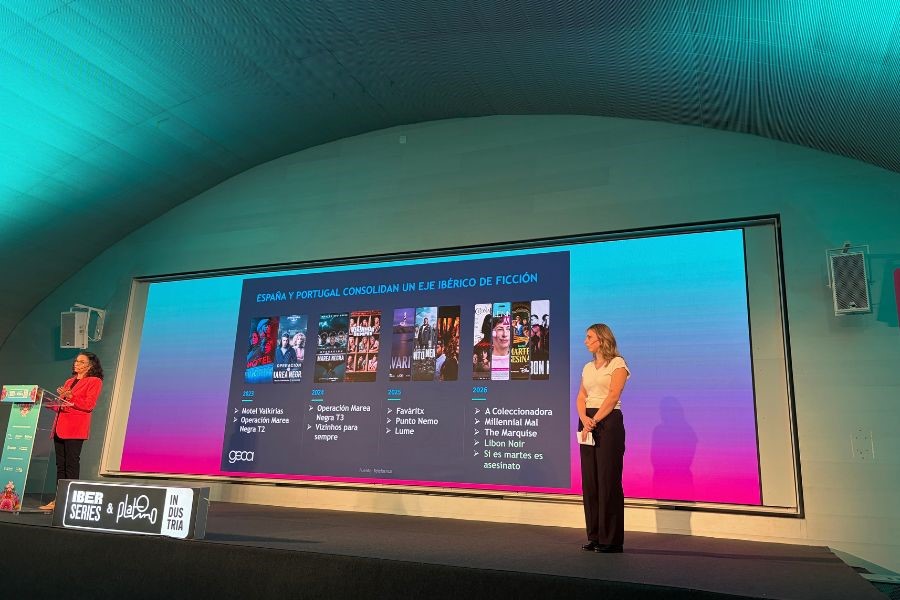
At the same time, Spain and Portugal are developing what GECA described as an increasingly consolidated Iberian fiction axis.
Recent productions demonstrate how producers, broadcasters, talent, crews and locations are increasingly moving between the two territories. Examples include Motel Valkirias, Operación Marea Negra, Favàritx, Punto Nemo and Lume, while the 2026 pipeline includes A Coleccionadora, Millennial Mal, The Marquise, Lisbon Noir and Si es martes es asesinato.
The trend is moving beyond one-off projects towards longer-term industrial relationships. Operación Marea Negra, for example, has reached three seasons through collaborations involving Ficción Producciones, Ukbar Filmes and several broadcasters and platforms, while newer projects continue to widen the number of companies and partners operating across the Iberian marke
Spain Becomes the Gateway for Europe-Latin America Coproduction