
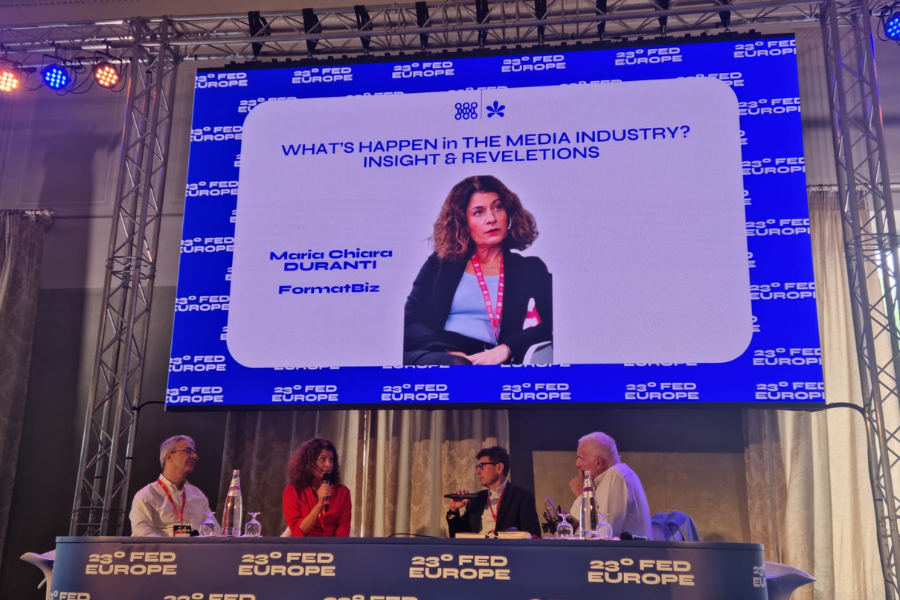
At the centre of the discussion was the increasingly blurred boundary between traditional television and digital platforms. While some argue that YouTube has effectively become the new television and that linear TV is in decline, Federico Di Chio offered a different perspective, stressing that linear television is not dying and continues to attract investment.
“TV is far from dying - confirmed Ondarza - although audiences are increasingly fragmented and classic TV is under pressure, people today watch more video content than ever in the past. The challenge is to define new profitable business models while delivering high quality content propositions. “
M. Chiara Duranti highlighted how YouTube productions can no longer be considered amateur content. Today, many creator-led projects are produced at a very high professional level, attracting the attention of major international groups. The example of Banijay’s collaboration with leading content creators, including the French case Stop the Train, shows how the creator economy is now becoming an integral part of the entertainment business.
The debate also addressed the growing role of artificial intelligence, one of the most discussed topics throughout the Lucca event. AI is rapidly entering the media value chain, from development and production to distribution and audience analysis, raising both opportunities and questions for the industry.
Another key theme was the rise of content creators as new industrial players. Far from being a marginal phenomenon, creators are building new models of production, engagement and monetization, especially among younger audiences. At the same time, the boom of Chinese microdramas is forcing European companies to reflect on short-form scripted content. However, the panel underlined that simply copying a trend is not enough: Europe needs to develop its own model, rooted in local storytelling, editorial quality and cultural specificity.
FED Europe Lucca confirmed its role as a valuable meeting point for professionals looking to understand how media, technology and creativity are converging. The event offered a clear message: the future of the industry will not be defined by the replacement of one model with another, but by the ability to combine linear TV, digital platforms, AI and creator-led content into new and sustainable forms of storytelling.
M. Chiara Duranti highlighted how YouTube productions can no longer be considered amateur content. Today, many creator-led projects are produced at a very high professional level, attracting the attention of major international groups. The example of Banijay’s collaboration with leading content creators, including the French case Stop the Train, shows how the creator economy is now becoming an integral part of the entertainment business.
The debate also addressed the growing role of artificial intelligence, one of the most discussed topics throughout the Lucca event. AI is rapidly entering the media value chain, from development and production to distribution and audience analysis, raising both opportunities and questions for the industry.
Another key theme was the rise of content creators as new industrial players. Far from being a marginal phenomenon, creators are building new models of production, engagement and monetization, especially among younger audiences. At the same time, the boom of Chinese microdramas is forcing European companies to reflect on short-form scripted content. However, the panel underlined that simply copying a trend is not enough: Europe needs to develop its own model, rooted in local storytelling, editorial quality and cultural specificity.
FED Europe Lucca confirmed its role as a valuable meeting point for professionals looking to understand how media, technology and creativity are converging. The event offered a clear message: the future of the industry will not be defined by the replacement of one model with another, but by the ability to combine linear TV, digital platforms, AI and creator-led content into new and sustainable forms of storytelling.