
Ten years ago, Netflix extended its service from around 60 countries to more than 190 territories in a single day. At the time, the narrative surrounding the company focused on its rapid globalization strategy: becoming global by investing deeply in local storytelling. That strategy has since transformed not only the streaming business, but also the international audiovisual ecosystem itself.
In 2015, Netflix launched its first original series produced outside the United States, Club de Cuervos, created in Mexico. Since then, the platform has evolved into a worldwide production engine, employing local crews, supporting regional businesses and contributing directly to national economies.
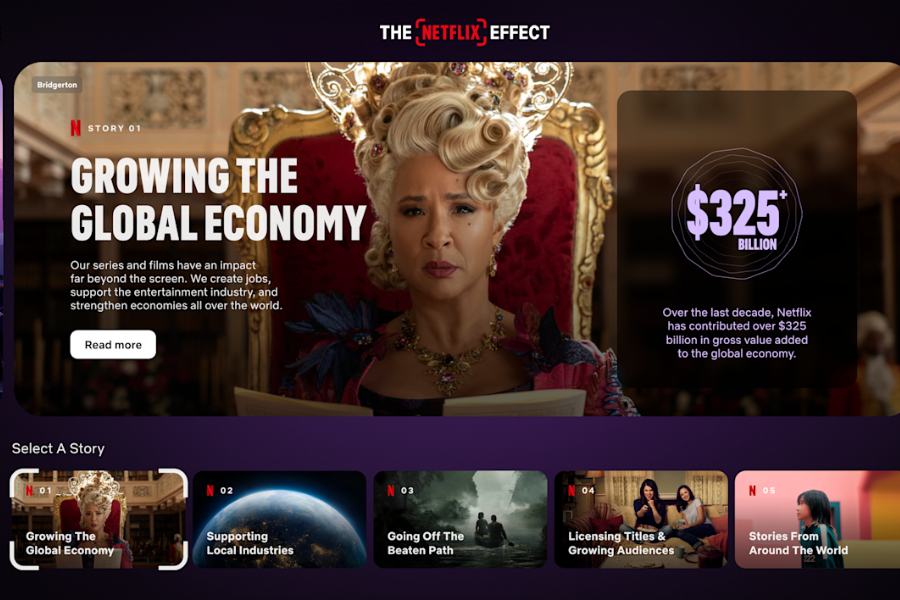
This is what Netflix now defines as the “Netflix Effect”: the economic, cultural and social impact generated by its productions around the world, far beyond viewing numbers and subscriber growth.
The company has officially presented a wide-ranging overview of how its original films and series have influenced local industries, employment, tourism, training, consumer trends and even language learning over the past decade. And the numbers reveal the scale of a model that has fundamentally reshaped the audiovisual sector.
Over the last ten years, Netflix says it has invested more than $135 billion in films and television series globally, generating more than $325 billion in economic impact and creating over 425,000 jobs connected to its productions.
But the most significant aspect of the “Netflix Effect” is perhaps not the financial scale itself, but the way productions become integrated into local territories.
The company repeatedly stresses that every Netflix production is considered a local production. Today its series and films are produced in more than 4,500 cities and towns across over 50 countries, involving local crews, suppliers, hospitality services, transport companies and small businesses.
One emblematic example is The Lincoln Lawyer, whose four seasons generated more than $425 million for the Californian economy. The series employed over 4,300 cast and crew members and filmed across more than 50 Los Angeles locations, including iconic landmarks such as Dodger Stadium and Grand Central Market.
At the same time, global franchises such as Stranger Things have become industrial machines in themselves. Across five seasons, the series created more than 8,000 production jobs and involved over 3,800 vendors across the United States.
For the Colombian thriller Frontera Verde, filmed in the Amazon rainforest, members of indigenous communities directly participated in the production. Before filming started, local community leader Walter Morales performed a blessing ceremony for the crew, while members of his family later worked as actors and assistants on set. Around 30 crew members came directly from the Amazonian area itself.
In Europe, meanwhile, the Swedish town of Strängnäs — located outside Stockholm — has quietly become one of the recurring hubs of Netflix reality production. Several European adaptations of Love Is Blind have been filmed there, transforming the small city into a long-running production centre for nearly 40 weeks every year. Hotels, restaurants, drivers, technicians, makeup artists and catering services all benefit from the constant presence of international crews.
The company cites the recent success of KPop Demon Hunters as a striking example. According to Netflix, the film triggered a 25% increase in travel bookings to South Korea, while language-learning platform Duolingo recorded a 22% rise in Americans studying Korean.
At a time when many traditional media companies are reducing investment and restructuring their content strategies, Netflix is instead reinforcing its industrial footprint. The company says it continues to invest tens of billions of dollars annually in content and production infrastructure, including studio facilities in territories such as Spain and New Jersey.
Training and professional development are also becoming part of the platform’s long-term positioning strategy. Over the last five years, Netflix has organised more than 1,000 training programmes and industry initiatives across more than 75 countries, reaching over 90,000 participants ranging from students to experienced professionals.
The strategy also includes investments in film culture and preservation. Netflix has restored historic venues such as The Egyptian Theatre in Los Angeles and Cinema Europa in Rome, while simultaneously supporting technological innovation for creators and production companies.
Presented The Netflix Effect on the Global Economy