
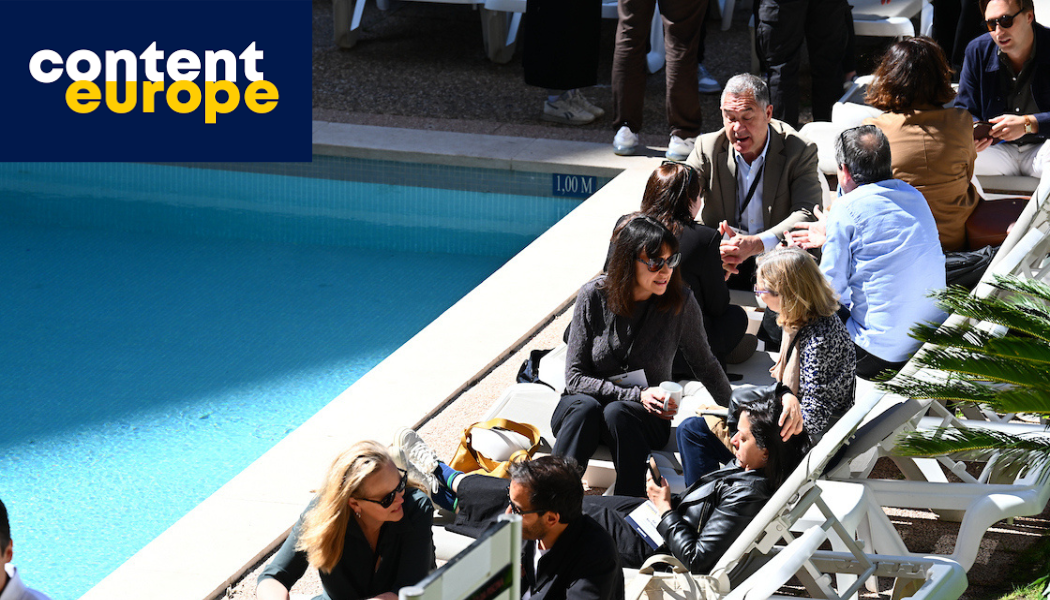
From the outset, it was clear that Content Europe was designed around functionality rather than spectacle, as the organizers opted for a compact, integrated environment where exhibition spaces, meeting areas, and networking zones coexisted seamlessly. This spatial strategy proved highly effective: delegates remained onsite, allowing meetings to flow organically into informal conversations across terraces, lounges, and bars. The result was a continuous, productive exchange that many described as both efficient and refreshingly relaxed.
Perhaps the most defining characteristic of Content Europe’s debut was its strong editorial focus on the formats business. This was not only visible on the exhibition floor, but especially evident in the titles and themes of the conference panels, where formats dominated the agenda.
Sessions such as “The Future of Formats: What Happens Next?”, “Formats Fundamentals: The New Shape of Finance and Acquisitions”, and “How to Create a Global Hit Format” clearly positioned formats as the core of the conversation. The Content Europe Global Formats Pitch Competition and The Traitors keynote on building a global franchise market-by-market further reinforced this direction.
Even within broader strategy sessions—such as “How to Get Your Show on” panels featuring major broadcasters including ZDF, TF1, TV4, NRK, SIC, Mediaset, Channel 4, Keshet 12, RTP, WBD Nordics, TV2 and Nat Geo—the underlying logic remained closely tied to format development, commissioning, and adaptation.
This emphasis reflects a wider industry reality. Formats—particularly in the unscripted space—offer scalability, repeatability, and cross-border adaptability. In an increasingly fragmented global market, these attributes make them one of the most resilient and commercially viable forms of intellectual property. By placing formats at the heart of its proposition, Content Europe aligned itself with a key driver of international trade, while still maintaining space for drama, factual, and kids content.
The event also succeeded in establishing a strong international footprint without becoming overwhelming. Participation from Southern Europe—especially Portugal, Spain, and Italy—was complemented by a notable presence from Turkey, Latin America, and parts of Asia. This created a marketplace that felt genuinely global, yet accessible and manageable.
The opening by Portugal’s Minister of Culture, Youth and Sport, Margarida Balseiro Lopes, underscored the institutional support not only to the event but to the all audivisual sector with an incentive scheme of 350 euros, designet to strengthen Portugal's industry.
Following this successful launch, organizers have confirmed that Content Europe will return to Lisbon from April 18 to April 20, 2027, adopting a Sunday–Tuesday schedule. This strategic shift is designed to align the event with StreamTV Europe (Lisbon, 20-22 Apri, 2027), enabling delegates to attend both markets within a single trip—an increasingly important consideration in an industry focused on efficiency and cost management.
Earlybird registration is already open, offering a 50% discount (€399) for those signing up before the end of May—further reinforcing the event’s positioning as an accessible, cost-conscious alternative to larger markets.
Perhaps the most defining characteristic of Content Europe’s debut was its strong editorial focus on the formats business. This was not only visible on the exhibition floor, but especially evident in the titles and themes of the conference panels, where formats dominated the agenda.
Sessions such as “The Future of Formats: What Happens Next?”, “Formats Fundamentals: The New Shape of Finance and Acquisitions”, and “How to Create a Global Hit Format” clearly positioned formats as the core of the conversation. The Content Europe Global Formats Pitch Competition and The Traitors keynote on building a global franchise market-by-market further reinforced this direction.
Even within broader strategy sessions—such as “How to Get Your Show on” panels featuring major broadcasters including ZDF, TF1, TV4, NRK, SIC, Mediaset, Channel 4, Keshet 12, RTP, WBD Nordics, TV2 and Nat Geo—the underlying logic remained closely tied to format development, commissioning, and adaptation.
This emphasis reflects a wider industry reality. Formats—particularly in the unscripted space—offer scalability, repeatability, and cross-border adaptability. In an increasingly fragmented global market, these attributes make them one of the most resilient and commercially viable forms of intellectual property. By placing formats at the heart of its proposition, Content Europe aligned itself with a key driver of international trade, while still maintaining space for drama, factual, and kids content.
The event also succeeded in establishing a strong international footprint without becoming overwhelming. Participation from Southern Europe—especially Portugal, Spain, and Italy—was complemented by a notable presence from Turkey, Latin America, and parts of Asia. This created a marketplace that felt genuinely global, yet accessible and manageable.
The opening by Portugal’s Minister of Culture, Youth and Sport, Margarida Balseiro Lopes, underscored the institutional support not only to the event but to the all audivisual sector with an incentive scheme of 350 euros, designet to strengthen Portugal's industry.
Following this successful launch, organizers have confirmed that Content Europe will return to Lisbon from April 18 to April 20, 2027, adopting a Sunday–Tuesday schedule. This strategic shift is designed to align the event with StreamTV Europe (Lisbon, 20-22 Apri, 2027), enabling delegates to attend both markets within a single trip—an increasingly important consideration in an industry focused on efficiency and cost management.
Earlybird registration is already open, offering a 50% discount (€399) for those signing up before the end of May—further reinforcing the event’s positioning as an accessible, cost-conscious alternative to larger markets.
photo by Simon Wilkkinson/SWpic.com