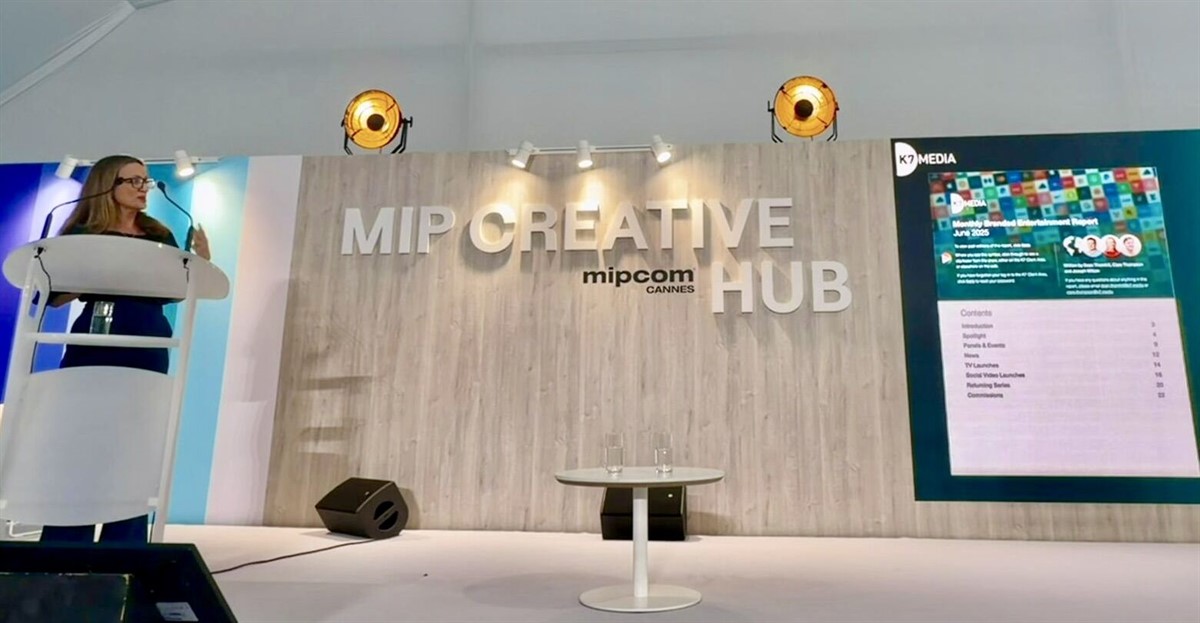

At this year’s MIPCOM (Cannes, October 13–16, 2025), Clare Thompson, Non-Executive Director at K7 Media, presented the consultancy’s latest study, “BrandStorytelling Summit: State of the Industry.” Her session provided an in-depth look at how brands are redefining entertainment, blending commercial goals with creativity, and reshaping the funding models of television and digital content.
According to data presented by Thompson (sourced from PQ Media, eMarketer, and Statista), global branded entertainment spending surpassed $150 billion in 2023, highlighting the growing integration between advertising and storytelling.
Experiential marketing led the charge with $82 billion, while native and content advertising — including branded videos, articles, and in-feed content — exceeded $108 billion. Influencer marketing reached $34 billion, with the US accounting for nearly 75% of total spend, though APAC and Europe remain the fastest-growing regions.
Product placement also continues to thrive, now valued at $29.6 billion, with television representing around 70% of that total. Meanwhile, podcasts and hybrid audio formats added another $2.2 billion, signaling that brands are finding new, less intrusive ways to inhabit audiences’ daily media experiences.
Thompson noted that AFP (advertiser-funded programming) and co-created content remain under-measured but strategically vital. Their budgets are often embedded in sponsorship and production deals rather than traditional ad spend. Yet the impact is visible across international markets — with examples like Cooking with the Stars (ITV/M&S), The Great Home Transformation (C4/IKEA), and Beer Masters (Amazon/AB InBev) showing how brand values can be seamlessly integrated into entertainment formats.
Other standout collaborations cited included Hair Power (C4/Dove), Foxys Fearless 48 (C4/Land Rover), My Greatest Shot (Sky/Adobe), and Summer on the Farm (ITV/Waitrose) — each illustrating a nuanced approach where brands serve as authentic co-authors rather than overt sponsors.
One of the session’s key discussion points was the potential of brand partnerships to sustain the “squeezed middle” of the non-scripted television market — shows too costly for traditional broadcasters yet too modest for streamer budgets. As Clare Thompson put it, “brands can be the missing piece in financing mid-scale entertainment that still has broad audience appeal.”
In practice, this means leveraging brand collaboration not merely for funding but for creative storytelling and audience connection — particularly in lifestyle, factual entertainment, and reality genres.
The branded revolution is not limited to unscripted content. In scripted, Thompson highlighted how brands are now aiming to be inside the entertainment, not just around it. This goes beyond classic placements to active story collaboration. Examples such as Dads (Apple TV+/Dove Men+Care), 5B (Netflix/Discovery/Johnson & Johnson), and The Cost of Winning (HBO/Gillette) show how brands can enhance credibility, social impact, and reach through authentic storytelling partnerships.
Meanwhile, The Great Home Transformation (C4/IKEA) and My Beautiful Green Home (ITV/Nationwide) embody a growing eco-conscious trend, as sustainability becomes a shared narrative space between advertisers and audiences.
K7 Media’s research also explored how brands are reinventing traditional TV genres for the digital-first generation. Classic TV ideas are being reborn online through brand-led web series, creator collaborations, and interactive campaigns. Brands are learning to “behave like broadcasters,” commissioning original content that prioritizes emotional resonance and shareability over hard-selling.
Thompson concluded with K7 Media’s “Seven Opportunities” for the future of branded storytelling:
Learn from global territory models — such as Drive to Survive and All or Nothing, which blend sports access with cinematic storytelling.
Invest in workplace and real-life access formats, inspired by successful Nordic examples like Finnish Truck Drivers.
Leverage streaming partnerships that combine visibility with long-tail value.
Explore hybrid audio-visual platforms like podcasts and live streams.
Embrace co-creation rather than sponsorship.
Center authenticity and purpose, aligning with social or environmental values.
Treat storytelling as the core of brand identity — not an accessory to marketing.
A Future Built on Authenticity
K7 Media’s Clare Thompson unveils the new branded content landscape at MIPCOM